
You've picked the robe colour, chosen slippers to match, and written the proposal card. Then you hit the box. It needs to look beautiful on opening, survive a trip through the post, and not turn a lightweight gift into an expensive parcel. That's the decision behind custom boxes Australia wide, and it's easier once you treat the box as a shipped product, not just a pretty lid.
Custom Box Types and Where Australians Use Them
A bridal box has two jobs that don't always agree. It must protect what's inside during handling and transit, then present those items as a gift the moment the lid lifts. If you choose by how important the occasion feels, you'll often oversize it. Choose instead by the largest set of items it must hold and by how it'll travel.
That's also the scale of the decision nationally. Grand View Research put Australia's custom packaging revenue at US$502.3 million in 2025, which helps explain why couples now face so many formats for what used to be a simple gift box choice.
Match the box to the moment
Hens party proposals usually need a coordinated set that travels to several addresses. Morning-of gifts need robes and pyjamas kept neat for photos. Thank-you boxes for bridesmaids, mothers and flower girls often mix soft apparel with small keepsakes, so separation matters more than extra space.
If you're still shaping the occasion itself, our guide to bridal boxes for proposals and thank-you gifts helps you pair the format with the role each person plays on the day.
Custom box types by occasion and contents
| Box type | Typical contents | Suited material | Personalisation to consider |
|---|---|---|---|
| Single-item gift box | One robe or one pair of pyjamas | Uncoated corrugated board with tissue | Monogram or name on the lid |
| Bridesmaid proposal box | Robe, slippers and proposal card | Corrugated board with removable paper insert | Recipient name and proposal wording |
| Hamper or bundle box | Several items such as flutes, pouches and robes | Double-wall corrugated board with folded fibreboard dividers | Bride tribe title and coordinated colour |
| Clutch or pouch mailer | Clutch, pouch or makeup bag | Sturdy paperboard sleeve | Initials or a pre-printed title |
| Bridal keepsake box | Cards, baubles and small mementos | Rigid board with removable sleeve | Wedding date and couple's names |
Three questions to answer today
- How many items go in the box? Count the bulkiest combination, not the smallest gift.
- Will it travel alone or in a bundle? A shipped presentation box needs a protective outer shipper, while a hand-delivered box may not.
- Will it be opened once or kept? A one-opening gift suits a lighter structure. A keepsake needs stronger corners and a finish that won't scuff in storage.
Your answers point to one row above. Start there, then size and personalise around that format rather than forcing every gift into one universal box.
Personalisation Choices That Hold Up in Production
Personalisation looks simple on a flat mock-up. Production adds folds, packing pressure, fingerprints and postage. The choices that hold up are the ones that stay legible and intact after all four.
Text, titles and placement
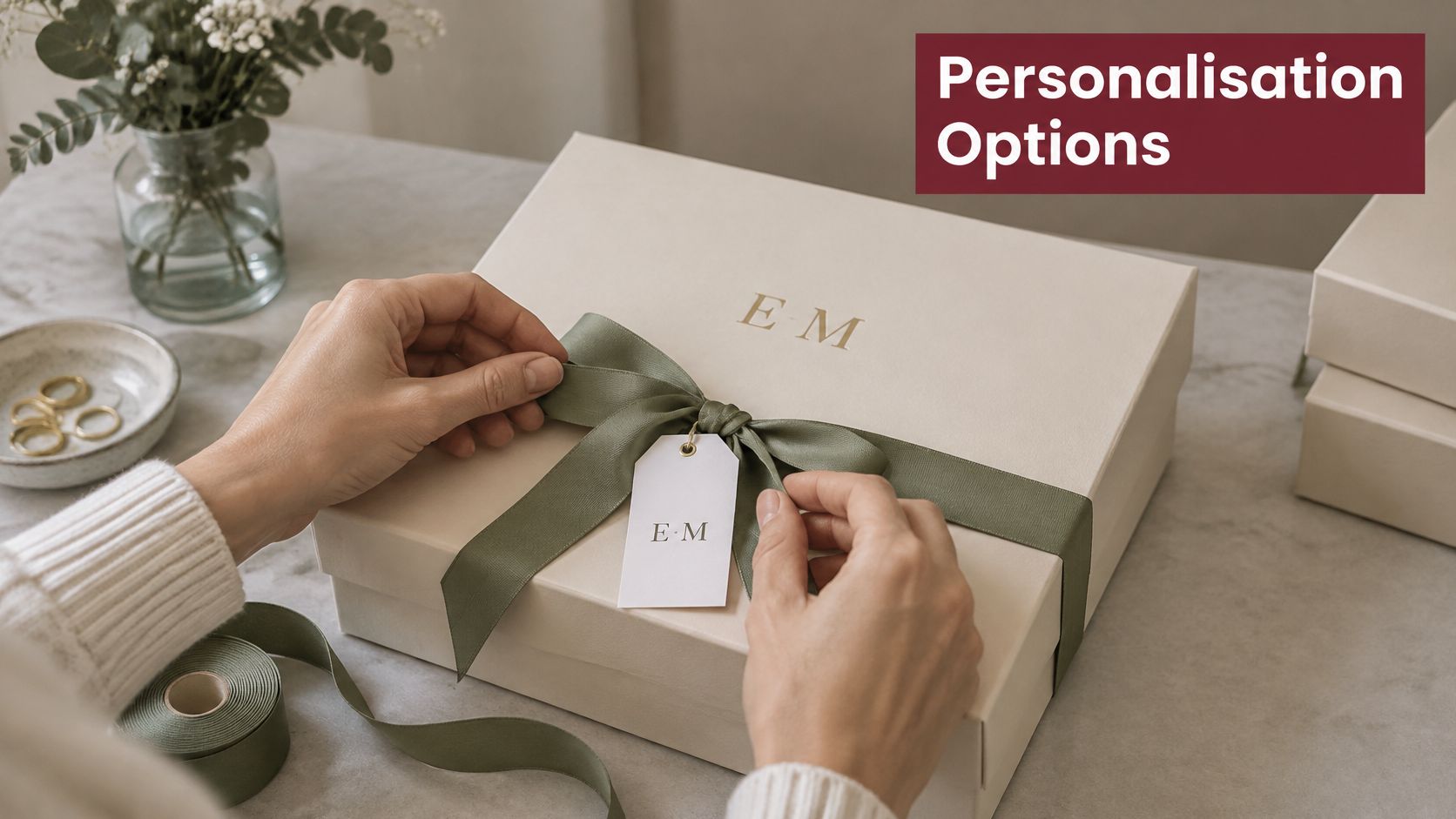
Monograms and initials work well on a lid or ribbon because short text reads cleanly at a glance. Pre-printed titles such as Bride, Bridesmaid, Maid of Honour, Mother of the Bride and Flower Girl suit bridal parties because one design can repeat across a coordinated set without resetting every box.
Placement changes the experience. A name on the lid is visible at the moment of opening and photographs well. A name on an inside flap keeps the outer box clean, which helps if you want gifting privacy during delivery. Long names may need a smaller font or a second line, so set a character limit before design begins and check the longest name in your party first, not the shortest.
For proposals, keep wording short. A question that needs three lines in small type won't read as a special moment. It'll read as a label.
Colour and finish checks
Don't approve colour from a screen alone. Screen colour rarely matches board colour, especially with blush, sage and champagne tones. Ask for a physical swatch or printed reference and view it in daylight beside your robe or ribbon colour.
Foil and hot-stamped finishes look striking on lids, but they can crack where board is folded or scored. Place them on flat panels away from creases. Light shades show fingerprints in transit, so they're better inside a protective outer carton or sleeve.
Choose personalisation that stays legible after packing and postage, not only on a flat mock-up.
That same thinking applies if you're coordinating packaging beyond the box. Our notes on customised gift bags for bridal gifting cover how names and titles carry across different gift formats without looking mismatched.
I would always proof the longest name, the lightest colour and any foil panel on the actual box format. Those three checks catch most production surprises before a full set is printed.
Box Sizes and Postal Limits to Plan Around
Start with whether your design can be lodged. Australia Post's size and weight guidelines set a maximum parcel weight of 22 kg, a maximum length of 105 cm on any side, and a maximum cubic volume of 0.25 m³.
Australia Post limits for custom boxes
| Limit or rule | Value | What it means for a custom box |
|---|---|---|
| Maximum parcel weight | 22 kg | Heavy hampers need a sturdy base and tight packing |
| Maximum length on any side | 105 cm | Long robe boxes or flat sleeves can exceed it |
| Maximum cubic volume | 0.25 m³ | Bulky decorative boxes use this allowance quickly |
| Minimum length and width for box-shaped parcels | 5 cm each | Sets the lower limit for compact keepsakes |
| Cubic weight for non-flat-rate packaging | Volume in m³ × 250 | A 40 × 30 × 15 cm box counts as 4.5 kg |
Why a light box can still post as heavy
For non-flat-rate packaging, cubic weight is the parcel volume in cubic metres multiplied by 250. A box measuring 40 × 30 × 15 cm has a volume of 0.018 m³, so its cubic weight is 4.5 kg even if the box and contents weigh only 2 kg. Empty space isn't free. It takes up transport room, and postage reflects that.
If you're sending several gift sizes together, it's worth checking how to book delivery for assorted box sizes so mixed proposal boxes and smaller accessory mailers don't create avoidable repacking at lodgement.
Measure the finished parcel
- Pack it fully with tissue, inserts and every item included.
- Measure length, width and height at the widest point of the closed parcel.
- Weigh the packed box, not the empty one.
- Calculate volume and cubic weight from those external measurements.
- Compare both weights and dimensions against the limits above.
Measuring the empty box is the common mistake. Tissue, dividers and a protective outer shipper all add size and weight that your postage decision has to include.
Pack so contents don't shift. Tissue and inserts should hold robes still and keep glassware from pressing into the lid, because in 2025, 29% of Australian consumers said damaged packaging would deter them from shopping with the same retailer again. An oversized box may need repacking or a different service, and a box that can't be lodged can't arrive as promised.
Materials That Balance Presentation and Recovery
Recyclable is a weak claim on its own. What matters is whether a material is recovered in Australia after the gift is opened, and the gap between board types is wide.
APCO's Australian packaging consumption and recovery data for 2022-23 recorded 2.897 million tonnes of corrugated cardboard packaging placed on the market, with 2.119 million tonnes recovered, a 73% recovery rate. Boxboard or cartonboard achieved only 35%, with 107,000 tonnes recovered from 301,000 tonnes placed on market.
Packaging recovery rates by material in Australia
| Material | Placed on market (2022-23) | Recovery rate | Design note for custom boxes |
|---|---|---|---|
| Corrugated cardboard | 2.897 million tonnes | 73% (2.119 million tonnes recovered) | Readily separated; suits the structural shipper |
| Boxboard or cartonboard | 301,000 tonnes | 35% (107,000 tonnes recovered) | Mixed materials can need extra sorting |
| Paper and paperboard, all uses | 3.805 million tonnes | About 65% | Makes up 54% of all packaging placed on the market |
A specification that separates cleanly
Use uncoated corrugated fibreboard for the structural box wherever protection allows. Pair it with a removable paper-based sleeve or label, water-based inks, and adhesives compatible with standard fibre recovery. That keeps the premium layer removable instead of permanently bonded to the structure.
Limit the components that reduce fibre recyclability:
- Laminated films and polymer coatings that coat the whole panel
- Plastic windows that can't be separated easily
- Foil-heavy finishes across large areas
- Foam or plastic inserts permanently bonded to the box
Folded fibreboard or moulded paper inserts protect flutes and keepsakes while staying closer to the paper stream.
Right-sizing is also a material decision. APCO's paper and paperboard factsheet puts paper and paperboard at 54% of all packaging placed on the Australian market in 2022-23, about 3.805 million tonnes. Oversized cartons use more of that board, add dimensional weight and need more void fill.
A reusable box only helps when someone genuinely reuses it. A heavy keepsake that travels empty can carry a larger footprint than a light, right-sized carton.
Add clear disposal guidance to your order or insert. Flatten the box and place it in the local paper and cardboard recycling stream, subject to council rules. A box can be technically recyclable and still end up in landfill if it's mixed, contaminated or too hard to separate.
Ordering Timelines and Buyer Protections
Work backwards from the event, not forwards from the day you feel ready to order. Personalised boxes have a proof stage that standard gifts don't, and that stage protects you more than any rush decision made later.
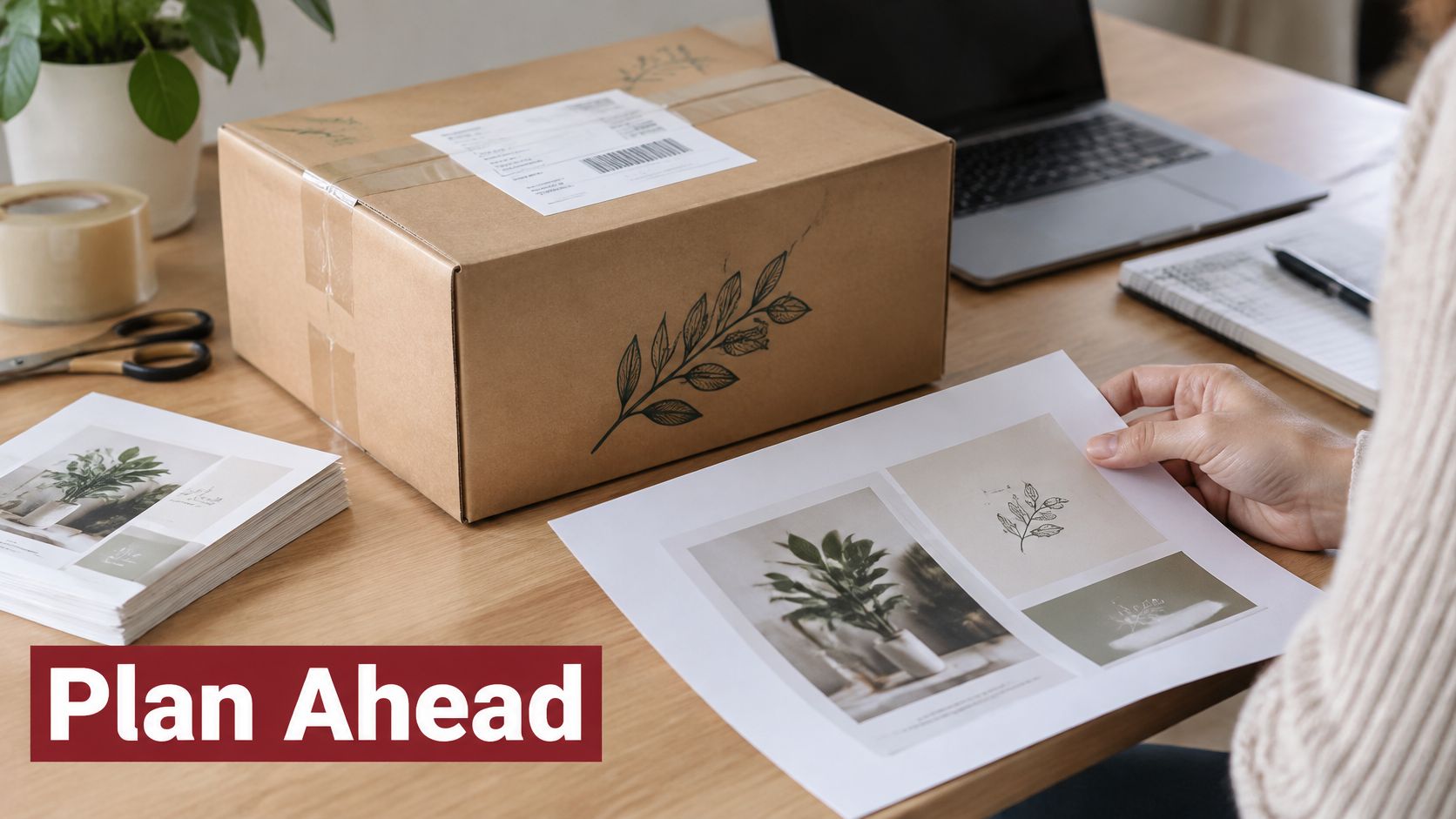
Build the timeline in reverse
- Fix the event date and delivery address for each recipient.
- Allow proof time to check and approve names, titles, colours and quantities.
- Allow production time after that approval, not before it.
- Allow tracked transit time to the actual postcode.
- Add a buffer for remote postcodes and for any reprint.
Our explainer on interstate shipping in Australia is useful at step four, when a bridal party is spread across states and one delivery estimate won't suit everyone. We dispatch orders from Sydney and ship Australia-wide, so distance from Sydney is worth factoring into that buffer.
The proof matters most because spelling, titles, colours and quantities are approved there. Once production starts from an approved proof, a dispute about a name you approved is hard to resolve. Read every name aloud, check titles against each recipient, and confirm quantities against your guest list.
What personalised does and doesn't change
Under the Australian Consumer Law, ACCC guidance on warranties and consumer guarantees confirms that consumer guarantees apply automatically and cannot be removed by a business's warranty or store policy. Remedies can include repair, replacement, refund or cancellation, depending on the problem.
Those guarantees include acceptable quality and matching the product description. For a custom box, that means the finished item should correspond with the agreed dimensions, materials, colour, printed wording, monogram and quantity. A reasonable artwork approval process is fine, but it doesn't override those guarantees if a box is faulty or materially different from its description.
A gift recipient may also hold rights, not only the purchaser, so keep the recipient's details and the correct product description on the order. When a box arrives, photograph it promptly if it's damaged or differs from the approved proof, and contact the seller with those photos. Clear records make a fair remedy much easier for everyone.
Confirm Your Box Brief Before You Order
A good custom box order starts as a one-page brief you can complete in one sitting. It stops the common pattern where a beautiful box is chosen first and the contents, postage and proofing have to squeeze in afterwards.
Your brief checklist
- Occasion and recipient such as bridesmaid proposal or morning-of thank-you
- Box type matched to those contents
- Item list with quantities for the largest gift in the set
- Finished packed dimensions and weight from your sizing check
- Personalisation text exactly as it should appear, including titles and spelling
- Colour reference taken from a physical swatch or printed sample
- Delivery postcode and required date, with a buffer before the event
Once that brief is set, choose the pieces that belong inside it. For personalised bridal robes, pyjamas, clutches, bridal boxes and proposal cards, we offer coordinated items that can be assembled into one set for a bride tribe or kept simple for a single gift. Shipping is offered Australia-wide, orders are dispatched from Sydney, and an express and rush order option is available at checkout if your timeline tightens.
Takeaway for your brief: Design the box around what it must hold, how it'll travel and how it'll be kept or recovered. Presentation comes last in the brief, even though it's first in the recipient's hands.
That order sounds backwards, but it's what makes the unboxing work. A right-sized box posts more efficiently, protects glassware and apparel properly, and gives personalisation a flat, clean panel to sit on. Your recipient won't see the cubic weight calculation or the proof check. They'll see a box that arrives intact, opens beautifully and feels made for them.
Build your brief first, then browse our bridal boxes, personalised robes, pyjamas, clutches and proposal cards to assemble a set that fits it properly. Start with the largest gift you're sending, confirm the packed size and proof details, and order with your event buffer intact.