
You're three hours into the wedding morning, one bridesmaid is having her hair pinned, another is searching for a missing earring, and the photographer is already capturing the room. The matching pyjamas looked charming online, but one waistband is digging in, a button is pulling across the bust, and the satin has become uncomfortably warm.
That's the difference between pyjamas that merely match and bridesmaid pyjamas plus size that work. For an Australian bridal party, the right choice depends on measurement accuracy, pattern shape, fabric performance and how comfortably each person can move through makeup, breakfast, photographs and the change into a dress.
Why Plus-Size Bridesmaid Pyjamas Deserve Real Thought
A bridal party's getting-ready clothes stay visible for much longer than most brides expect. They appear while hair and makeup are happening, during gift exchanges, over coffee and mimosas, and in the photographs taken before everyone changes into formalwear.
A bridesmaid in a larger size shouldn't have to choose between being included in the visual theme and feeling comfortable. Yet plus-size sleepwear is often ordered as an afterthought, usually from a generic multi-pack with limited grading and little room through the bust, waist or hips.
Australia's sizing environment makes that approach especially frustrating. An independent Australian sizing analysis reported that 36.9% of Australian women are considered plus-size, size 18 and above, while 9.1% are considered straight-size, size 4 to 8. The same analysis found that only 6.3% of Australian clothing retailers sell plus-sizes, size 16 and above, which helps explain why shoppers often turn to specialist ranges and personalised options. The Australian sizing analysis places inclusive sleepwear in its proper context. This is a substantial audience, not a token extension to a standard range.
The wedding-morning test
Ask whether each bridesmaid can sit, reach, bend, lift an arm and walk around without adjusting her clothing. A shirt that looks polished while standing may pull across the chest when someone hugs the bride. Shorts that seem fine in a product photograph may ride up once a bridesmaid sits on a bed.
Climate matters too. A humid morning in Brisbane calls for a different decision from a cool winter gathering in Hobart. Your bridal party might spend hours in a warm room with hair tools running, several people moving around and layers of activity before the ceremony begins.
Practical rule: Choose getting-ready pyjamas for the whole morning, not just the first photograph.
The most successful groups I've styled treat sleepwear as a real outfit. They check the size chart, ask each bridesmaid what she feels comfortable wearing, and choose a coordinated look that accommodates different bodies instead of pretending one cut will suit everyone.
What Plus-Size Actually Means in Australian Sizing
The number on a pyjama label is only a starting point. Australian brands use different grading systems, different amounts of ease and different interpretations of alpha sizes, so two sets marked with the same AU size can fit quite differently.
Start with the retailer's bust, waist and hip measurements, then compare those measurements with the person wearing the set. Don't convert from a dress size and stop there. Sleepwear needs enough room for sitting, sleeping and movement, especially when the fabric has little stretch.
Australian plus-size charts commonly extend from about AU 16+ to AU 28+, while some made-to-order labels go further. One Australian size guide lists these measured body points for plus sizes: 115 cm bust at 16+, 131 cm at 22+, and 149 cm at 28+. The Australian plus-size sleepwear sizing reference demonstrates why a broad size label alone isn't enough.
Read the measurements, not the marketing
Use the chart below as an orientation tool, not a substitute for the specific retailer's measurements. Another Australian chart, from Target, gives the following body measurements for its plus-size ladder. Target Australia's women's plus-size chart lists the bust, waist and hip figures directly.
| AU Size | Bust (cm) | Waist (cm) | Hip (cm) |
|---|---|---|---|
| 16+ | 115 | 103.5 | 121 |
| 22+ | 131 | Not specified in this chart | Not specified in this chart |
| 28+ | 149 | 141.5 | 163 |
The most important measurement depends on the cut. For a button-through top, bust usually controls the fit. For trousers, hips and the rise matter more than the waist alone. If the pyjamas have a fixed waistband, check the waist measurement carefully. If they have a soft drawstring or elastic, look for enough room through the hips and thighs.
Why size labels vary
Some brands use numeric AU/NZ sizes, while others rely on XS through 5XL or 7XL. Australian retailers also provide international conversions, so an AU size may appear alongside US, UK or EU equivalents. Target's wider size-conversion guide shows why shoppers should compare the actual centimetre measurements before ordering.
For a mixed group, record each bridesmaid's measurements privately and order by fit, not by the desire to keep the labels identical. A set that fits comfortably in the top and bottom is more successful than a smaller label that looks uniform on the order spreadsheet.
For more guidance on selecting inclusive bridal sleepwear in Australia, see this plus-size bridesmaid robe guide.
Cuts and Silhouettes That Flatter Curvier Figures
The best cut gives the body room where it needs room and creates shape without squeezing it. That sounds obvious, but many bridal pyjama sets are graded from a straight-size base, leaving fuller busts, upper arms and hips to absorb the strain.
A V-neck or notch collar is usually more flattering than a high crew neck. It opens the neckline and creates a cleaner vertical line through the chest. A button-through shirt with a slight A-line shape gives the bust space while falling away from the waist, especially when the back includes a yoke that allows movement across the shoulders.
A wrap-style top can work beautifully for changing cup sizes because the wearer controls the overlap. It needs enough coverage and a secure tie, though. A wrap that opens every time someone reaches for a champagne flute isn't practical wedding-morning clothing.
The details that make a difference
Look closely at where each feature sits on the body.
- Waist definition: Choose a soft tie, gentle elastic or a relaxed seam. A rigid waistband can dig in when the wearer sits.
- Trouser shape: Wide-leg and straight-leg bottoms skim over the hip more gracefully than narrow legs that cling at the thigh.
- Sleeves: A sleeve ending at or just below the elbow offers coverage without the abrupt visual cut of a tight cap sleeve.
- Top length: A longer, slightly curved hem helps prevent the shirt from riding up over the stomach or hips.
- Button placement: Buttons should lie flat across the bust. If the gaps open while standing, the shirt is already too small.
Cuts I'd approach cautiously
Clingy polyester sets reveal every line underneath and tend to twist as the wearer moves. Dropped-waist tops shorten the torso visually and can sit awkwardly across a fuller stomach. Cap sleeves often finish at the widest point of the upper arm, while very narrow shorts may become uncomfortable when bridesmaids sit for photographs.
A high-low hem or relaxed nightshirt can be a strong alternative for someone who doesn't enjoy trousers. The point isn't to put every bridesmaid in the same silhouette. The point is to give everyone a shape that behaves well on her body while keeping the group visually connected.
Fabric Choices for Australian Wedding Mornings
Glossy satin photographs beautifully in a controlled product shoot. It's less reliable in a busy Australian bridal suite, particularly when the set is polyester satin and the room is warm.
Polyester satin can cling, trap heat and catch flash across every fold. It also tends to show static, makeup marks and wrinkles. That doesn't make satin forbidden, but it does mean the fabric should be chosen deliberately rather than treated as the default bridal option.
Cotton satin offers some sheen with a more grounded feel. Modal usually drapes softly and feels smooth against the skin, making it useful for long getting-ready mornings. Cotton jersey, gauze and soft woven fabrics can be more forgiving when bridesmaids need to move, sit and layer.
| Fabric | Breathability | Drape and Photo Finish | Re-wear and Care | Best For |
|---|---|---|---|---|
| Polyester satin | Low to moderate, depending on weave | Glossy, polished and reflective | Can crease, cling and need careful washing | Cool rooms and short photo sessions |
| Cotton satin | Better airflow than polyester satin | Soft sheen with less glare | Practical for repeated wear when washable | Brides wanting polish with comfort |
| Cotton | Generally breathable | Matte, relaxed and natural | Usually easy to wash and re-wear | Warm Australian mornings |
| Modal | Soft and comfortable against skin | Fluid drape with a refined finish | Good lounge value, follow care label | Long makeup sessions and travel |
| Lace | Depends on backing fabric | Decorative and feminine | Trim may need gentle care | Details, overlays and cooler settings |
| Polyester blend | Varies by fibre mix | Can drape well but may cling | Check washing instructions carefully | Transitional climates and budget-conscious groups |
Let the weather lead
For spring and summer weddings, I'd favour cotton, modal or a breathable blend over heavy, glossy satin. A short-sleeve shirt and roomier trouser can look just as elegant as a satin cami, while offering better coverage and movement.
For cooler climates, brushed cotton, ribbed knits and lace-trimmed long sleeves create warmth without requiring a bulky robe. Ask whether the fabric can survive ordinary washing. Dry-clean-only sleepwear is rarely a sensible choice for a mixed bridal party, especially when the gift needs to be worn again.
The organic cotton pyjama guide is useful when you're comparing a softer, more wearable direction with a purely photo-first satin look.
How to Measure a Bridal Party the Right Way
Measure each bridesmaid before placing the group order. Guessing from a dress size is the fastest way to create a box of mismatched expectations.
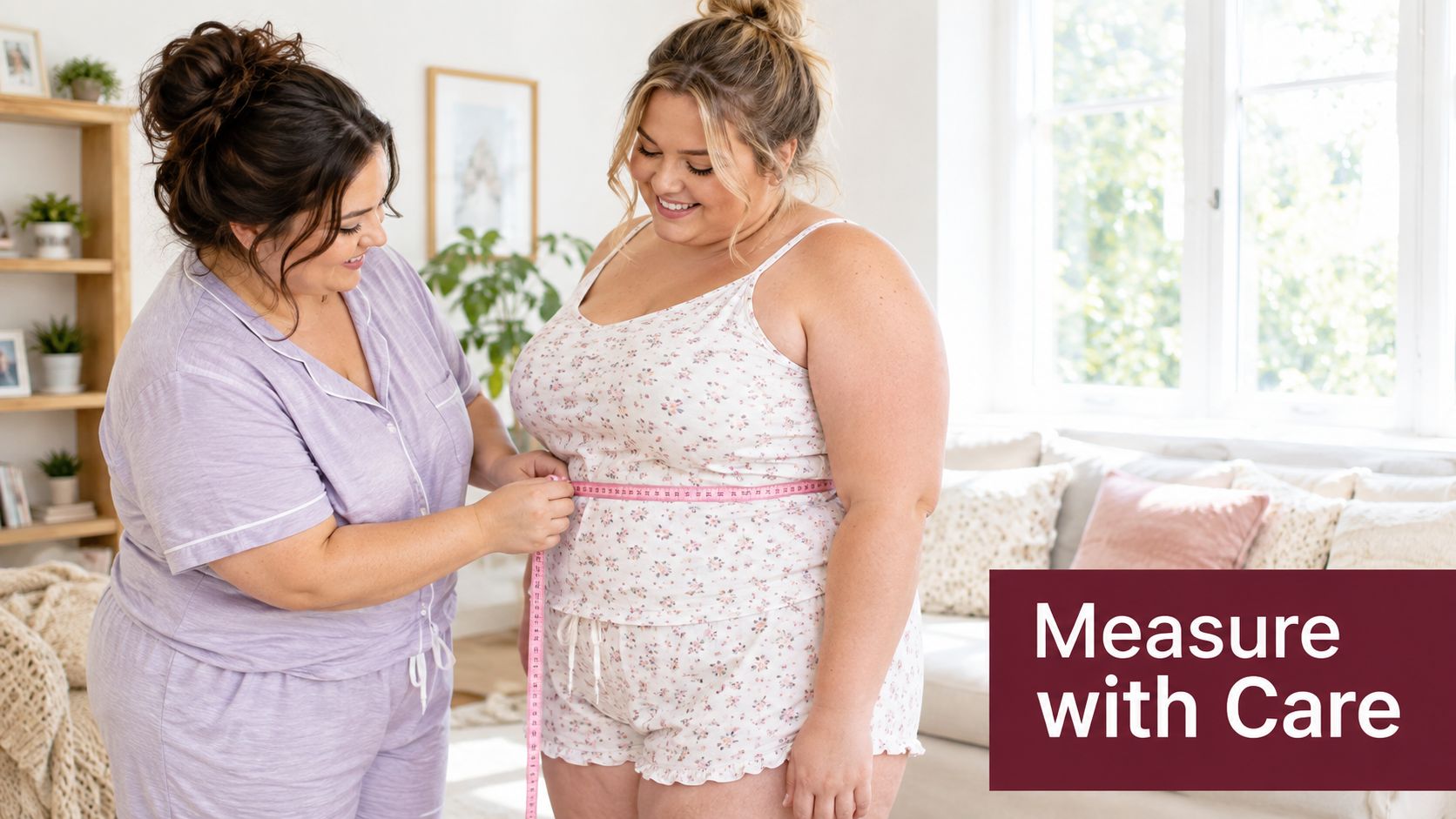
Use a soft tape measure and ask each person to measure herself, or have a trusted person help. Measurements should be taken over light clothing, with the tape level and comfortably firm rather than pulled tight.
Take the five measurements that matter
- Bust: Measure around the fullest point, keeping the tape straight across the back. This usually determines the size of a button-through or fitted top.
- Natural waist: Find the narrowest point of the torso, or use the point where the body naturally bends when leaning sideways. Don't suck in.
- Hips: Measure around the fullest part of the hips and seat. This often controls trouser sizing more than the waist.
- Inseam: Measure from the crotch to the ankle or the preferred trouser length. It's particularly helpful for tall bridesmaids or wide-leg styles.
- Shoulder-to-shoulder: Measure across the back between the shoulder points. This helps identify whether the shirt will restrict arm movement.
Write the results in a private note using the same format for everyone: name, bust, waist, hip, inseam, preferred top size, preferred bottom size and fabric preference. Don't circulate the measurements in the group chat. The bride or organiser can use them to order without turning bodies into a public discussion.
Handle split sizing honestly
A bridesmaid who wears a smaller size on top and a larger size on the bottom isn't an exception. She's showing why separate sizing matters. If the retailer sells separates, order the top and bottom independently. If it only sells sets, size for the larger measurement and check whether the top can be altered or comfortably tucked.
For someone between sizes, choose the larger size when the fabric has little stretch or the garment has a fixed waistband. Extra ease can often be managed with a tie or relaxed hem. A tight bust or hip can't be made comfortable by positive thinking.
Fit note: Bust and hip measurements usually matter more than the number printed on the size label.
Don't rely on a generic chart that stops before the fuller sizes in your group. If the chart doesn't show the measurements you need, contact the seller before ordering and ask how the garment is graded.
Matching the Tribe Without Forcing Identical Sets
Identical pyjamas are not automatically the most inclusive choice. The same cami in a small size and a much larger size can have a different strap width, neckline proportion and body length, so the two garments may not create the same visual effect.
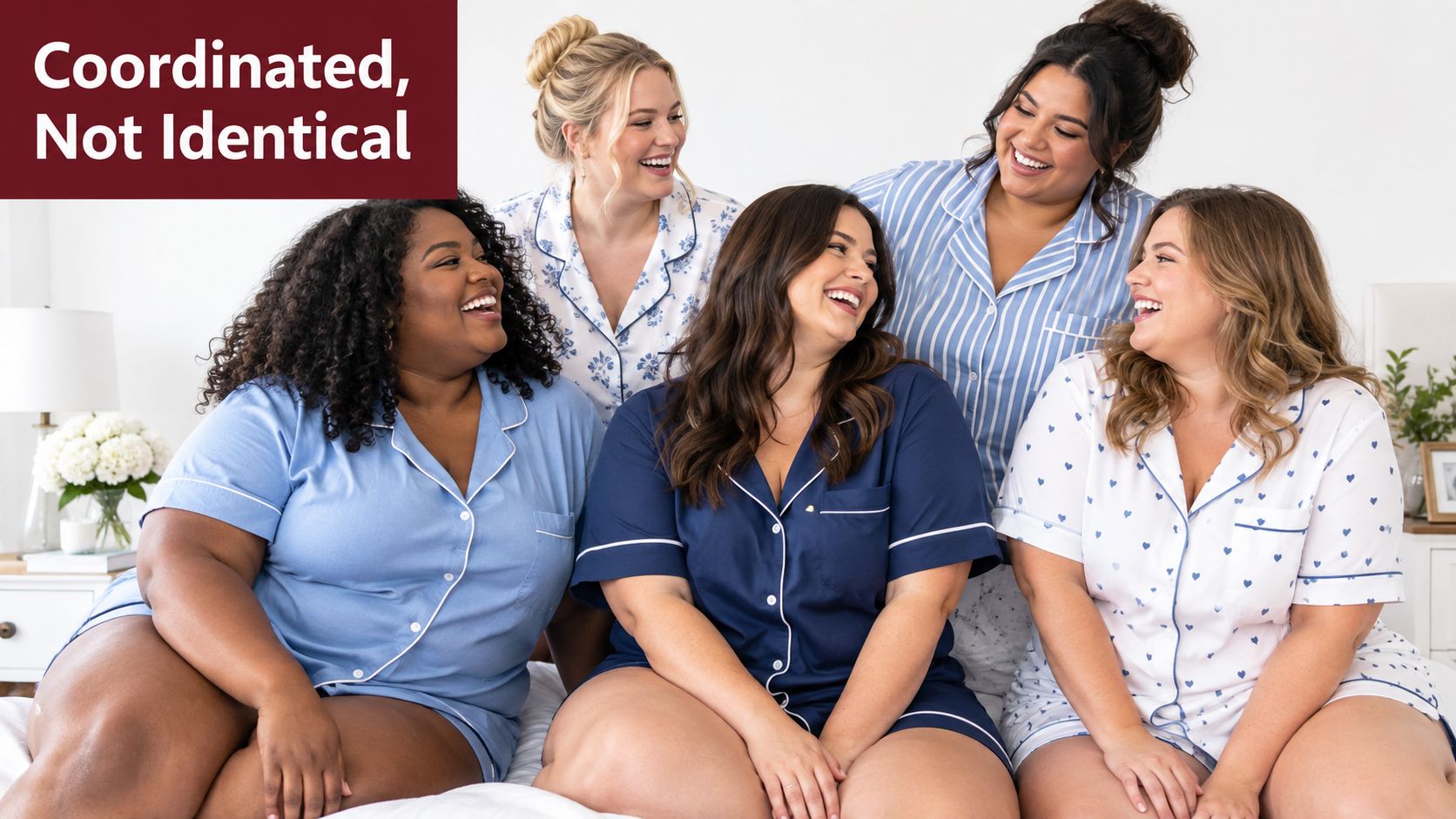
I prefer a coordinated-not-identical approach for mixed-size bridal parties. It respects personal comfort while giving the photographs a deliberate, cohesive finish.
Use three visual anchors
Choose a shared colour family first. Two related shades, such as dusty rose and muted mauve, can look more dimensional than forcing every person into one exact colour.
Keep the fabric consistent where possible. Cotton with cotton, matte satin with matte satin, or modal with modal will photograph more harmoniously than a shiny cami beside a heavy brushed set.
Finish with one repeated styling cue. White piping, matching lace trim, the same sleeve length or a consistent monogram position can tie different silhouettes together without highlighting who needs a different cut.
This approach also works beautifully for a destination celebration or estate-grown wine weddings, where a relaxed, coordinated morning look suits the setting without making every bridesmaid dress like a clone. Kunde Winery's estate-grown wine weddings offer useful inspiration for couples planning a celebration where the atmosphere matters as much as the palette.
Personalise with purpose
Monogramming adds meaning when it identifies the wearer or marks the occasion. Initials, a first name or a simple bridal-party title can turn a practical garment into a keepsake.
Don't add personalisation merely because every item has an embroidery option. Choose one placement, one thread colour and one lettering style. A left-chest mark often stays visible across different shirt cuts, while a centred-back design may disappear beneath a robe or fold into the fabric.
Brief the group positively: everyone is choosing the same colour family and fabric, while each person can select the cut that lets her move comfortably. That language makes inclusion part of the design, not a special accommodation.
Bundles, Hampers, and Personalised Gifting Ideas
A thoughtful hamper starts with the garment, not the extras. Build a core bundle for each bridesmaid, then add shared details that make the group feel connected.
A practical core might include a top, bottom, robe and socks. For a warmer wedding, replace the robe with a lightweight layer or choose a short-sleeve set. For a cooler celebration, add a soft long robe rather than forcing everyone into a camisole.
Build each hamper in layers
Place the pyjamas at the base of the box, folded with the monogram visible. Add the robe next, followed by an eye mask, a small candle and a handwritten note. Keep fragile pieces such as glassware or keepsake cards protected at the top, with tissue paper separating anything that could snag the fabric.
The wedding hamper guide can help you shape the gift around the occasion rather than filling a box with unrelated items.
For monogram placement, think about the garment's proportions. On a size 18 cami, a centred mark may sit neatly on the chest. On a size 28 long-sleeve shirt, a left-chest placement often remains more balanced and visible, especially when the wearer adds a robe.
Spend where comfort needs it
A mixed-size group doesn't need identical spending on identical garments. If one bridesmaid prefers a long nightshirt for modesty, order that silhouette in the same fabric and colour family. If another needs separate top and bottom sizing, allocate the budget to the correct fit rather than adding an unnecessary accessory.
You can create tiers without making the gifts feel unequal:
- Core gift: Coordinated pyjamas with a handwritten note.
- Comfort gift: Pyjamas, robe, socks and an eye mask.
- Keepsake gift: Personalised sleepwear, a robe, a candle and a wedding-day accessory.
For postage, pack each bridesmaid's complete set together and label the contents discreetly. Keep the group order organised with a private spreadsheet listing garment cut, size, colour, monogram text and delivery address.
Order early enough to inspect everything before the wedding. The best time to deliver a group order is two to three weeks before the wedding, leaving room to identify a sizing problem and arrange an exchange without turning the final week into a shipping emergency.
Shipping, Returns, and Reassurance for Australian Shoppers
A group sleepwear order needs a simple logistics plan. Ask the seller about dispatch timing, domestic delivery, international fulfilment, consolidated invoices and whether parcels can go to separate addresses.
Some Australian retailers advertise dispatch windows of five to ten business days, but that timeframe can change when personalisation, made-to-order sizing or a busy wedding season is involved. Treat dispatch and delivery as separate stages, and ask when the order is expected to leave the warehouse.
Questions to ask before checkout
- Delivery timing: Is the stated window for dispatch or arrival?
- Personalisation: Does embroidery add processing time?
- Group packing: Can all sets ship together?
- Addressing: Can the seller split delivery between the bride and individual bridesmaids?
- Exchanges: Can an unworn set be swapped if the fit isn't right?
- Hygiene conditions: Must liners, tags and packaging remain intact?
- Faults: What happens if a button, seam or hem arrives damaged?
Use the table below as a planning framework, then confirm the actual terms with the retailer. Shipping fees, thresholds and delivery estimates vary by business and destination.
| Option | Typical Timeframe | Cost Threshold | Notes |
|---|---|---|---|
| Domestic standard shipping | Varies by retailer and destination | Check the seller's current policy | Allow additional time for regional delivery |
| Domestic express shipping | Varies by service | Check the seller's current policy | Useful for late orders, but not a substitute for checking stock |
| Personalised order | May require extra processing | Check the seller's current policy | Confirm embroidery timing before payment |
| Group order | Depends on the slowest item | Ask about combined shipping | Request one dispatch plan and a consolidated invoice |
| Exchange | Depends on retailer policy | Postage may apply | Keep garments unworn, unwashed and complete with hygiene liners |
Run a pre-wedding fit check
Open every parcel as soon as it arrives. Have each bridesmaid try on her set over light clothing, check the bust and hip ease, sit down, raise both arms and walk around. Photograph any fault or incorrect item immediately, then contact the seller in writing with the order details.
Australian Consumer Law provides baseline protections when you buy from an Australian business online. Consumer Victoria explains that online purchases from Australian businesses are covered by consumer guarantees, while the ACCC's consumer guarantees guidance states that guarantees include acceptable supply and suitability for the stated purpose, with services also expected to be provided with reasonable care and skill and within a reasonable time when no time has been agreed.
Those protections don't remove the need to read the store's exchange policy. They do give Australian shoppers a clear framework when an item arrives faulty, fails to match its description or isn't supplied as agreed.
For a bride organising a mixed-size group, the order is ready when every bridesmaid can move comfortably, the fabrics suit the climate, and the styling looks intentional without requiring identical bodies. Choose the cut before the monogram, measure before ordering, and give the group time to try everything on. Browse Get Spliced's bridal pyjama collection when you're ready to assemble a personalised, coordinated getting-ready look for your Australian wedding morning.
Start your group order by recording each bridesmaid's bust, waist, hip and preferred silhouette, then choose a breathable fabric and a coordinated colour plan. Place the order early, request personalisation details in writing, and schedule a private try-on well before the wedding day so every member of your bridal party feels comfortable, included and photo-ready.