
A robe can look perfect on the hanger and still fail in the first five minutes of a wedding morning. If the front pulls apart when you sit, or the sleeve binds when you lift your arms, the label hasn't done its job. A good plus size robe is chosen in centimetres, tested in motion, and only then personalised.
Why a Plus Size Robe Is a Mainstream Bridal Need
She sits for makeup, settles into the chair, and the crossover parts at the bust. She lifts both arms while her hair is sectioned, and the belt rides up while the front opens again. Nothing has gone wrong with her body. The robe doesn't have enough wrap, sleeve room, or length for the movements of the morning.
That's a mainstream fitting problem, not a rare special order. In 2024, 36.9% of Australian women were considered plus-size, defined as wearing size AU 18 or above, according to Mys Tyler Insights' Australian Edition 2024 dataset of more than 32,000 women. A robe range that stops comfortably below that point leaves a large part of a typical bridal party to improvise.
What Plus Size Means for a Robe
For getting-ready wear, plus size shouldn't mean one curvy template scaled up. It means reliable coverage from about AU 16 upward across different combinations of bust, waist, hip, upper arm, and height. The average Australian woman wears AU 16, according to the Grant Thornton and Power Retail report, so AU 16 to AU 20 belongs in the centre of bridal planning.
The garment's job is simple. It should stay closed, let the arms move, and look calm in photos. If you have to hold it shut with one hand, it isn't performing the first part of that job.
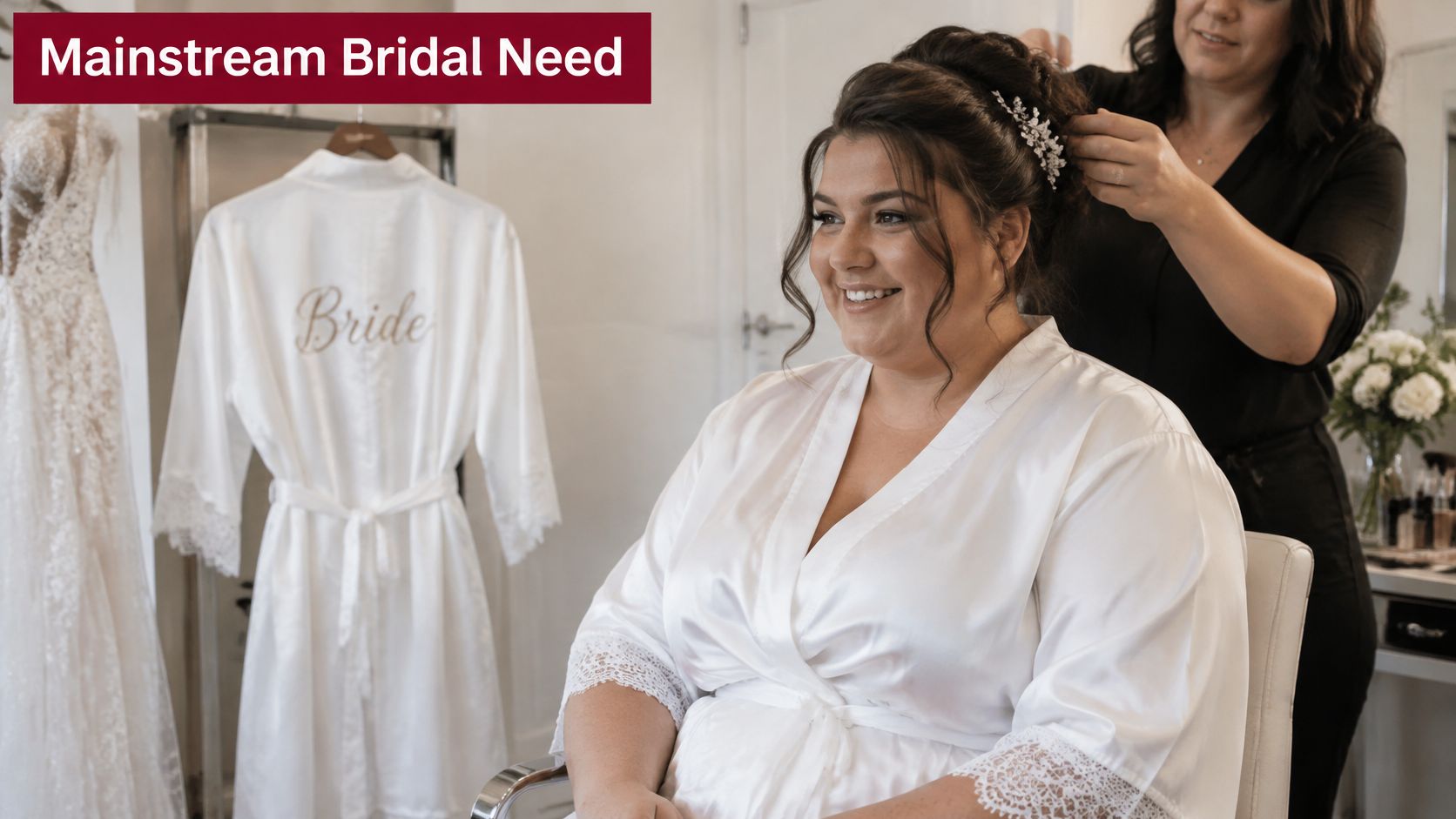
Labels won't tell you enough on their own. XL, 18, and one size can describe different garment widths from one brand to the next, and a one-size wrap often runs out of overlap at the bust or hip. Treat those words as a starting point for questions, not as a fit guarantee.
Before you fall for a colour or fabric, fetch a tape measure. You'll use it to choose the size, test satin, lace, or floral in motion, coordinate the whole party, and check that monogramming and care will work together. Fabric comes second. Fit decides whether the fabric gets a chance to look good.
Size to Your Largest Measurement Not the Label
Measure over the undergarments and slip you'll wear on the morning. A robe fitted over a thin camisole can behave differently over a structured bra, pyjamas, or a slip dress. Stand relaxed, keep the tape level, and don't pull it tight enough to compress soft tissue.
Australian Standard AS 1344 identifies bust, waist and hip as the three foundational measurements for women's clothing sizing, measured over foundation garments, as set out in the Australian Standard AS 1344 preview. For a wrap robe, bust and hip control overlap and mobility, while waist helps you judge belt length and whether the front will gape once tied.
Size the plus size robe to the largest of bust, waist and hip, and let the tie and overlap handle the smaller points.
Measure in This Order
Write all five figures down before you open any size chart.
- Bust: Measure at its fullest point, with the tape level all the way around.
- Waist: Measure at the natural narrowest point, relaxed and not sucked in.
- Hip: Measure at its fullest point with your feet together.
- Upper arm: Measure at its fullest point so you can compare it with sleeve circumference.
- Height and robe length: Record your height, then measure from the shoulder toward the floor to the hem length you want.
Length deserves the same care as width. If you're comparing proportions across different garments, you can check jacket sleeve and body length using the same shoulder-to-hem thinking, then apply that discipline to the robe chart. A robe can fit around your body and still be too short when seated, or pool dangerously if you're petite.
Which Measurement Sets a Plus Size Robe
| Situation | Size to this | Why it decides | Still check |
|---|---|---|---|
| Bust is the largest point | Bust band on the chart | The wrap must close when you sit and lean | Belt taking in a smaller waist |
| Waist is the largest point | Waist plus tie ease | A hard belt gapes the front or digs in | Hip overlap when you walk |
| Hip is the largest point | Hip band | The crossover has to stay closed over the seat | Hem clearance on stairs |
| Full upper arm | Sleeve circumference | Narrow sleeves block hair and photos | Shoulder drop on a kimono cut |
| Tall or petite | Robe length, not the size number | Body fit can still be too short or pool on the floor | Sleeve length |
| Measurements span two or more bands | Largest of bust, waist and hip | A wrap cannot shrink the biggest point | Ease for sitting and a slip |
| Published AU 2XL benchmark | 115–122 cm bust, 100–108 cm waist, 123–130 cm hip | External chart only, not a national standard | That robe's own finished measures |
Say your bust falls in one band, your waist in a smaller band, and your hip in the largest band. You choose the hip band, then use the belt to bring in the waist. If your upper arm is full, that winning size still needs a sleeve circumference that clears your arm with room to raise it.
The published AU 2XL figures in the table are an external Australian-market benchmark, not a universal standard and not a substitute for a seller's finished garment measurements. Australia doesn't currently have a nationally mandatory women's clothing-sizing standard, and the Australian Fashion Council labelling guide notes the earlier standard was withdrawn in 2009. That's why an 18 from one brand may not match an 18 from another.
Body Measurements Versus Garment Measurements
Your body measurement is the tape around you. The finished garment measurement is the robe itself, and it must be larger so you have wearing ease for sitting, reaching, photography, and layering over sleepwear. Close satin needs more ease than a loose kimono because satin shows every pull and has less visual forgiveness when the crossover is stretched.
Do a one-minute check before ordering. If a page only lists S to L or one size, ask for finished bust, hip, sleeve circumference, belt length, and robe length. If those numbers aren't available, you're being asked to guess at exactly the points where a wrap usually fails.
Fabric Choices and the Getting-Ready Fit Test
Fabric changes how the same measurements feel. Satin slides and shines, lace adds texture and possible sheerness, and a floral print can shift the visual focus across the body. Judge each one by what happens in a makeup chair, near hair tools, and in warm rooms, not just by a flat product photo.
Satin, Lace and Floral Robes Side by Side
| Style | Hand-feel | Best moment | Watch-out |
|---|---|---|---|
| Satin | Smooth, high sheen | Morning photos and a clear monogram | Clings if tight; heat marks the surface |
| Lace trim or all-lace | Textured, sometimes open | Classic white bridal and mothers | Snags on jewellery; needs a slip if sheer |
| Floral | Printed, often softer | Hens and bridesmaid colour stories | Large motifs can overwhelm bust and hip |
| Long robe with slip | Layered, more coverage | Modesty moving between rooms | Hem trip risk; warmer in summer |
| Short wrap | Light, easy arm movement | Makeup chairs and humid venues | Less leg coverage in photos |
Satin reads cleanly in soft morning light and gives a monogram a smooth background. Sized to your smallest measurement, though, it clings across the largest point and turns a small pull into a visible shine line. If you're weighing that finish, our guide to choosing a satin dressing gown for wedding mornings will help you compare drape and coverage before you commit.
Lace gives classic bridal texture, especially as a trim on cuffs and hems. An open lace can catch on a ring, a makeup brush ferrule, or the loop of a towel, and an all-lace robe may need a slip for comfortable coverage between rooms. Run your jewellery hand lightly across the trim before the morning. If it snags in a quiet fitting, it'll snag faster when you're carrying flowers, a phone, and a glass of water.
Floral prints carry a colour story for bridesmaids who aren't in white. Look at motif placement over the bust and hip, because one oversized flower centred on the crossover can dominate every photo. A smaller, evenly spread print usually sits more calmly across a fuller body and across a mixed-size bridal party.
Length is a fabric decision too. A long robe offers coverage for walking between rooms and can look elegant standing, but the hem becomes a trip risk on stairs and around hair and makeup equipment. A short wrap frees the legs and arms and stays cooler in humid Australian venues, though you'll want to check seated leg coverage from the photographer's angle.
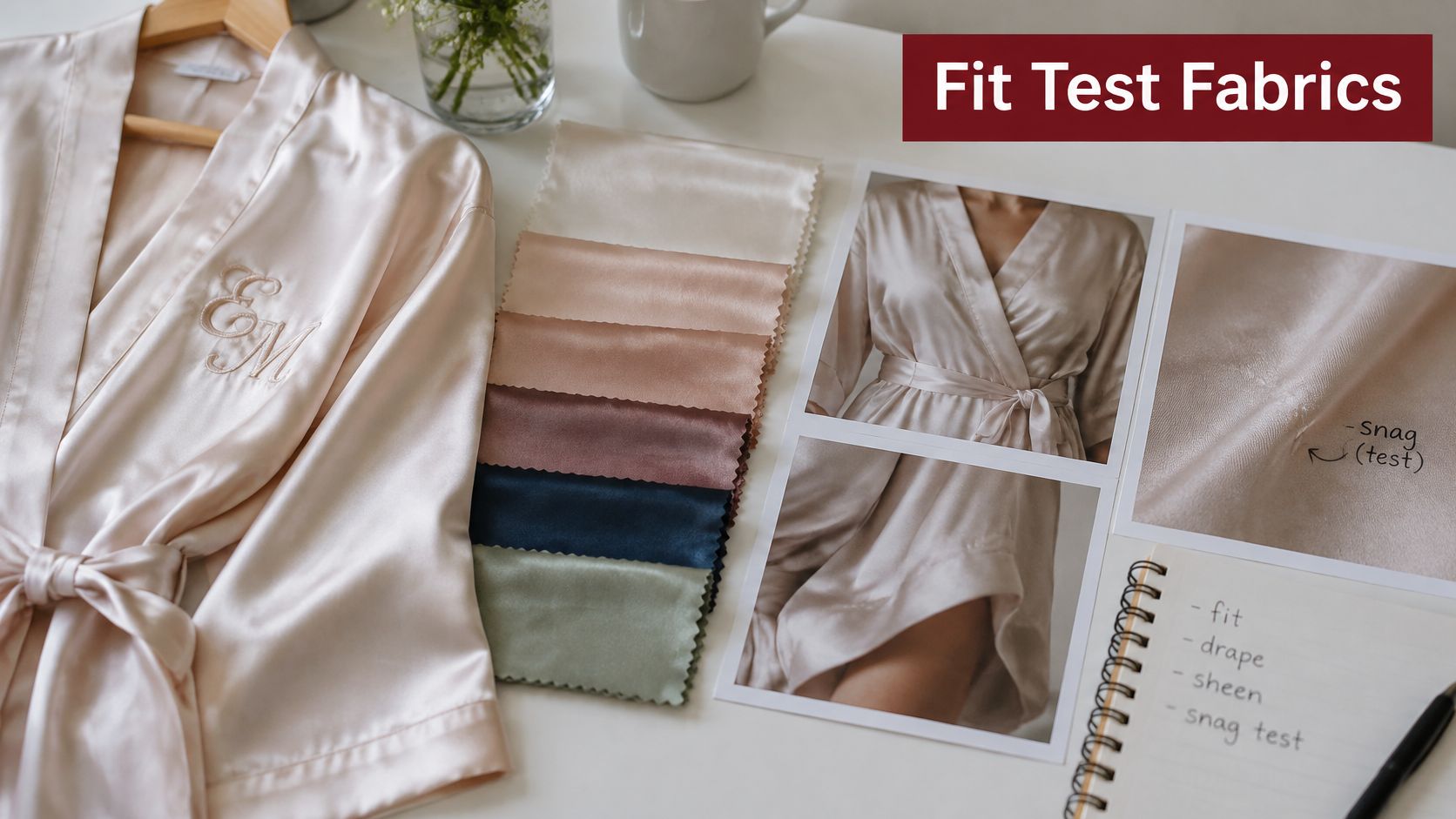
Run the One-Hour Fit Test
Treat the robe as a working garment for about an hour, not as a photo prop. Australian online retail data identifies "wrong size or fit" as the leading return reason, cited in 43% of returns, and women return products more often than men, 31% compared with 25%, according to Australian online retail return reporting. Testing early gives you time to exchange a plain robe before any lettering makes that harder.
Work through these movements in order, wearing the slip or pyjamas planned for the day.
- Sit in the makeup chair: Cross and uncross your legs, then check the crossover and hem.
- Lean forward: Reach toward a mirror as if checking foundation or lashes.
- Lift both arms: Hold them up as if your hair is being sectioned and pinned.
- Walk a set of stairs: Carry something small so you can't hold the front closed.
- Bend for a clutch: Pick it up from a low table or the floor without adjusting the belt first.
A pass means the crossover stays overlapped by about a hand's width, the sleeves clear your upper arms, and the belt ties without leaving a hard ridge at your waist.
Check temperature while you're moving. A robe that feels fine for a standing photo can feel warm after hair tools, bright lights, and a room full of people. If you're overheating, a shorter wrap or a looser kimono-style cut may serve you better than choosing a thinner version of the same restrictive shape.
Check the belt separately. It should tie at a comfortable point, stay tied while you walk, and release easily when it's time to change without disturbing hair or makeup. If you must pull it hard to keep the front closed, the belt is compensating for missing fabric.
If the front gapes, the sleeve binds, or the hem catches underfoot, go up a size or change silhouette. A generous wrap or loose kimono gives you adjustability that a fixed, close layer can't. The belt can tidy a smaller waist, but it can't create overlap at a bust or hip that was never given enough cloth.
Robes for Brides Bridesmaids and Flower Girls
A coordinated bridal party doesn't need identical bodies or identical numeric sizes. Harmony comes from colour, trim, fabric family, and lettering style, while each robe is sized to the person wearing it. That approach looks more polished than forcing everyone into the same cut and hoping the belts hide the differences.
The bride might choose a longer white or ivory robe for the main photographs, with enough length to stay composed while seated. Bridesmaids could wear a shorter satin or floral robe in the wedding colour, sized individually so the crossover behaves the same way in every photo. Our Australian guide to plus size bridesmaid robes is useful when you're coordinating several sizes without making anyone the exception.
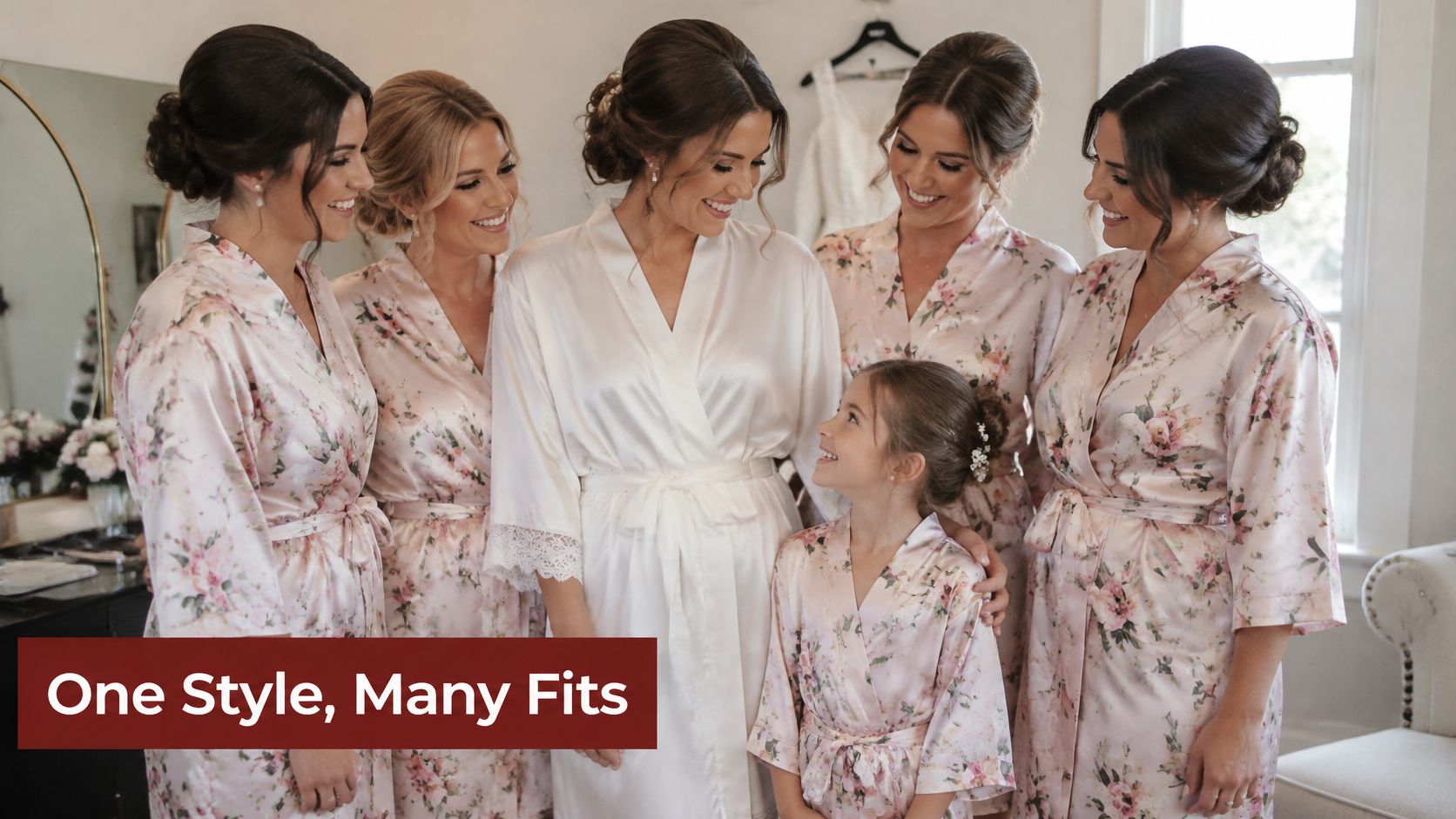
A mother of the bride or groom usually needs a length that stays closed while she moves between rooms, greets family, and helps with final details. She doesn't need a miniature version of the bride's robe. Give her the same measurement care, then choose a colour and length that suits her role and comfort.
A flower girl needs a child-proportioned robe, never a cut-down adult XL. Adult proportions put the belt, sleeves, and crossover in the wrong places for a child, even if the overall width seems generous. Keep her wording simple and age-appropriate, and prioritise a hem she can walk in safely.
Personalising Without Spoiling the Fit
Use a name, initial, or title such as Bride or Maid of Honour, placed where the belt won't fold across the stitches. Lettering across the back usually avoids the tie zone, but check the exact placement against the wearer's shoulder and waist position. If you're planning the wording as part of a gift, Jolitee's guide to monogrammed bridesmaid gifts offers helpful context for choosing names, initials, and titles.
Order lettering earlier than plain robes, and confirm every size before embroidery begins. A personalised robe is harder to exchange if the largest measurement was guessed. Matching crossover slippers or a small keepsake box can finish the set, but only after each robe size and wording line is settled.
Keep one worksheet row per person with these fields.
- Name and role: The wearer and the exact title, if any.
- Largest measurement: The biggest of bust, waist, and hip, plus upper arm where sleeves matter.
- Length and colour: The robe length required and the agreed colour.
- Exact wording: Spelling, capitalisation, and placement checked by the wearer.
That single page prevents the common mix-up where colours match beautifully but two people receive each other's sizes. It also makes monogram checks calm rather than relying on memory during a busy ordering session.
Care Labels for Satin Lace and Monograms
Read the care label before you buy, not after the first wash. Under Australia's Consumer Goods (Care Labelling) Information Standard 2023, suppliers may provide care instructions in English, use the five internationally recognised care symbols, or use both, according to the Australian care labelling guide. Those five categories cover washing, bleaching, drying, ironing and professional care.
The instructions must suit the whole garment, including fibres, dyes, lace, beading, trims, linings, and embroidery. That's the detail bridal shoppers miss. The satin panel might tolerate a gentle wash while the lace, dye, or stitched lettering needs a softer path.
Your Pre-Buy Label Check
- Fibre content: Know what the robe and trims are made from before choosing a wash.
- Washing method: Confirm whether it's cold hand wash, machine wash in a bag, or professional care only.
- Bleach warning: Check whether bleach is prohibited, especially for white robes you may want to brighten later.
- Drying method: Look for air-drying instructions and whether tumble drying is barred.
- Ironing limit: Confirm the permitted heat before you try to remove travel creases.
Satin usually fails from heat. Don't use a hot iron or tumble dryer if the label forbids them, because the surface can mark and lose its smooth sheen. Hang the robe so creases can relax, and use only the heat level the label allows.
Lace and stitched letters need gentle handling so the wording doesn't pucker and the trim doesn't distort. The same caution used to protect delicate wedding dress embellishments applies here in miniature. Wash gently if permitted, reshape the robe while damp, and dry it flat or supported rather than letting wet lace stretch under its own weight.
If the label allows washing, do a trial wash separately from dark towels well before the wedding morning. You'll catch dye transfer, shrinkage, or lettering puckering while there's still time to adjust. Our own care instructions for personalised pieces are worth keeping with the robe if it'll become a keepsake after the day.
Be wary of vague guidance. If the only instruction is a spot-clean line with no wash, dry, or iron direction, ask before you buy or personalise. A robe worn for one morning still deserves care information that protects every component, not just the main cloth.
Order the Size That Matches Your Largest Point
Make the decision in five short actions.
- Write down your five figures: Bust, waist, hip, upper arm, and the robe length you want.
- Order to the largest point: Choose by the largest of bust, waist, and hip, then confirm the seller's finished garment measures leave wearing ease.
- Choose fabric and length for the venue: Satin, lace, or floral, and long or short, should suit the temperature and the photographs.
- Repeat per person: Match colour and monogram wording across the party rather than forcing one size onto everyone.
- Read the care label before lettering: Confirm the wash, dry, and iron path while an exchange is still simple.
That order matters. Measurements first, silhouette second, personalisation last. Reversing it is how a beautiful monogram ends up on a robe that gapes in the makeup chair.
At Get Spliced, our Personalised Bride Robes come in sizes S, M, L and XL. Our robes are available in satin, lace and floral styles, in multiple colours and sizes, and we sell personalised bridal robes, slippers and accessories for a complete getting-ready set. Those options give you a clear brief to work from, but they don't remove the need to check the chart.
Be plain about the limit. XL is not every body, and a label alone shouldn't be stretched to cover measurements it wasn't cut for. If your largest point sits beyond a conventional XL garment's finished measures, choose a style whose chart clearly clears that point. A robe that closes with ease will always photograph better than a smaller robe pulled shut.
Your tape measure gives you the authority in this purchase. Use the largest figure, demand the finished garment numbers, run the movements, and only then add the name or title. That's how a plus size robe stops being a hopeful label and becomes a calm, reliable part of the morning.
Start with your five measurements, then choose the Get Spliced robe whose finished chart clears your largest point with room to sit, reach, and tie the belt comfortably. Add your personalisation once the fit is certain, and you'll have a getting-ready robe that looks elegant in photos and still feels secure when the morning starts moving.