

You're halfway through hair and makeup when someone realises the getting-ready room is across the hall. Another bridesmaid is searching for her phone, your mum is balancing a coffee, and the photographer wants everyone on the bed for one more robe photograph. Bare feet might look effortless, but cold floors, bathroom tiles and frantic stair trips quickly make footwear part of the wedding-day logistics.
The right ladies fluffy slippers should do more than match your robes. They should feel comfortable for a long morning, stay secure while people move around, and arrive in sizes that work for every member of your bride tribe. A beautiful pair is useful. A beautiful pair with a dependable sole and a sensible fit is far better.
Why the Right Fluffy Slippers Matter for Your Bridal Party
The morning of a wedding rarely unfolds in one neat room. You'll move between bedrooms, bathrooms, balconies, hallways and photography spots while wearing a robe or pyjamas, carrying personal items and trying not to disturb the makeup artist's setup. That's why slippers deserve the same practical attention as your bridal boxes, champagne flutes and coat hangers.
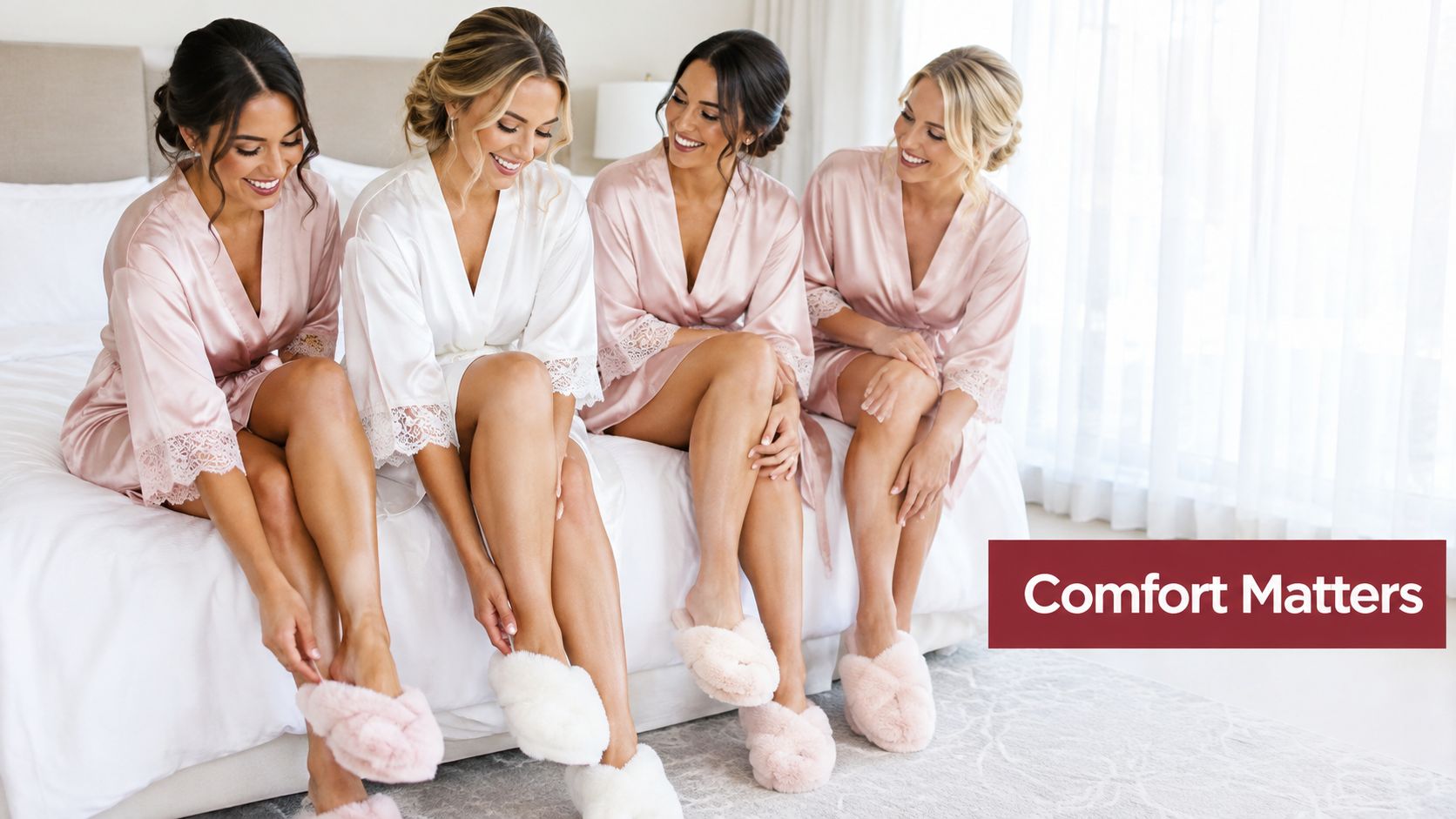
Suppose your bridesmaids are wearing coordinated satin robes in a soft neutral colour. Matching fluffy slippers immediately make the group look intentional in photographs, but the visual effect only works if everyone can walk comfortably. A loose heel, slippery sole or lining that overheats can turn a thoughtful gift into something people remove within minutes.
Australian household data places slippers inside the wider clothing and footwear category, not in a separate ladies' fluffy-slipper product line. The Australian Bureau of Statistics Household Expenditure Survey recorded average household clothing and footwear spending of $44 per week in 2015–16, unchanged in nominal weekly terms from $44 in 2009–10. After inflation, category spending declined by 1.4%, while total average household expenditure rose from $1,236 to $1,425 per week, an increase of 15%. The figures don't establish a national fluffy-slipper market size, but they do show that this purchase competes with other discretionary clothing, footwear and gifting decisions.
Stylist's rule: Treat slippers as part of the getting-ready experience, not as disposable photo props.
Your setting matters too. A home wedding in South Australia may have a very different rhythm from a hotel preparation suite or a venue with polished floors. If you're considering the wider atmosphere of a South Australian celebration, this guide to McLaren Vale wedding charm offers useful inspiration for shaping the day's location and mood.
Before ordering personalised pairs, review this practical guide to bridal party slippers. It's the kind of preparation that prevents a last-minute scramble when one person's “usual size” turns out to be different from everyone else's.
Choosing Materials for Warmth and Comfort
A fluffy slipper can feel luxurious at first touch and still become uncomfortable after a morning of wear. Warmth comes from the lining, while lasting comfort depends on breathability, shape retention and the sole beneath it. Choose the material combination according to the venue, the season and how long your group will remain on their feet.
Start with the lining
Faux fur and sherpa-style linings create the plush texture most brides want for photographs. They're particularly appealing for winter weddings, cool early mornings and venues with hard floors. The problem is that dense fibres can compress and retain heat, so a very thick lining isn't automatically the most comfortable choice for everyone.
Soft cotton blends can feel lighter and more breathable. They're a sensible option for warmer Australian conditions or for bridesmaids who dislike an overly padded feel. Look for a lining that feels soft without forcing the foot upward inside the slipper, because reduced internal space can affect fit and heel retention.
Examples such as sherpa slippers for women can help you compare the look and construction of a warmer plush style before choosing a bridal-party set. Use the product description to check the upper, lining and outsole rather than judging quality from the photographs alone.
Check the outer shell and sole
The outer fabric needs to hold its shape through sitting, standing and repeated movement. Satin can create an elegant bridal look, while fleece and cotton-feel textiles often offer a more relaxed finish. For a matching robe set, the slipper doesn't need to copy the robe fabric exactly. It needs to complement its sheen, colour and level of formality.
A good construction balances three elements:
- Plush interior: Comfortable against the skin without crowding the toes.
- Structured upper: Secure enough to stop the foot sliding sideways.
- Resilient outsole: Stable for indoor movement and appropriate for the surfaces in the venue.
For a cool-weather celebration, pair a fuller lining with a breathable robe or pyjama fabric so the outfit doesn't become too warm. For a summer morning, prioritise a lighter interior and avoid assuming that maximum fluff equals maximum comfort.
Read this practical guide to winter wedding accessories when coordinating slippers with robes, pyjamas and other seasonal details. Material choice should support the entire outfit, not compete with it.
Mastering Fit and Sizing for Every Tribe Member
A personalised slipper can carry the right name and still be the wrong gift if the heel slips, the toes feel cramped or the lining packs down after the first wear. Fluffy interiors compress over time, so a pair that feels close-fitting out of the box may become loose. Collect measurements from each wearer instead of assigning one “standard” size to the whole bridal party.
An Australian study of 107 women found that 72% wore a size different from their measured foot length under US sizing, while 65% differed under EU sizing. It also found that 59% selected a larger US size and 52% selected a larger EU size than their measured foot length indicated. A familiar shoe size is therefore a poor substitute for measurement. Check the seller's own chart before placing a group order, as recommended by The Australian sizing research.
Use one measurement method for everyone
Ask each wearer to measure both feet while standing. Weight-bearing changes foot length and width, so a seated measurement can mislead you.
- Place the foot on paper. Keep the heel lightly against a wall and mark the furthest toe.
- Measure both feet. Compare the larger measurement with the retailer's chart.
- Record width and instep concerns. Note wide feet, high insteps and whether the wearer plans to use socks.
- Identify the sizing system. Confirm whether the chart uses Australian, US, EU or a combined range.
- Allow controlled room. The lining needs space, but excess length encourages heel lift.
- Test the heel. Compress the plush lining by hand, then take 10–15 normal steps. The heel should stay seated. This measurement and step-test approach is supported by Australian falls research in the University of Wollongong footwear study.
Do not size up automatically for thick socks. Extra length can make a slip-on unstable on stairs once the lining settles. For someone between sizes, assess the slipper's shape, heel structure and actual chart measurements before choosing.
Organise the order like a stylist
Create a register listing each person's name, measured foot length, width notes, chosen size, title and colour. If the supplier's grading or lining thickness is unfamiliar, order a small contingency quantity before the event. Personalisation does not fix poor fit, and exchanges may take time.
Fit each pair while the wearer is standing, preferably later in the day when feet may be slightly larger. The University of Western Australia also highlights adequate toe width and depth, a secure heel seat and non-slip tread. Those checks apply to leisure slippers during hours of bridal preparation. Review the UWA foot-protection guidance before approving one design for the group.
Prioritising Safety and Grip for Indoor Use
A bridal party can slip before the photos begin. A fluffy upper may look secure while its outsole skids on polished tile, and decorative soles often prioritise appearance over traction. Indoor use still includes bathroom floors, timber, carpet transitions and stairs, so check the base as carefully as the lining.
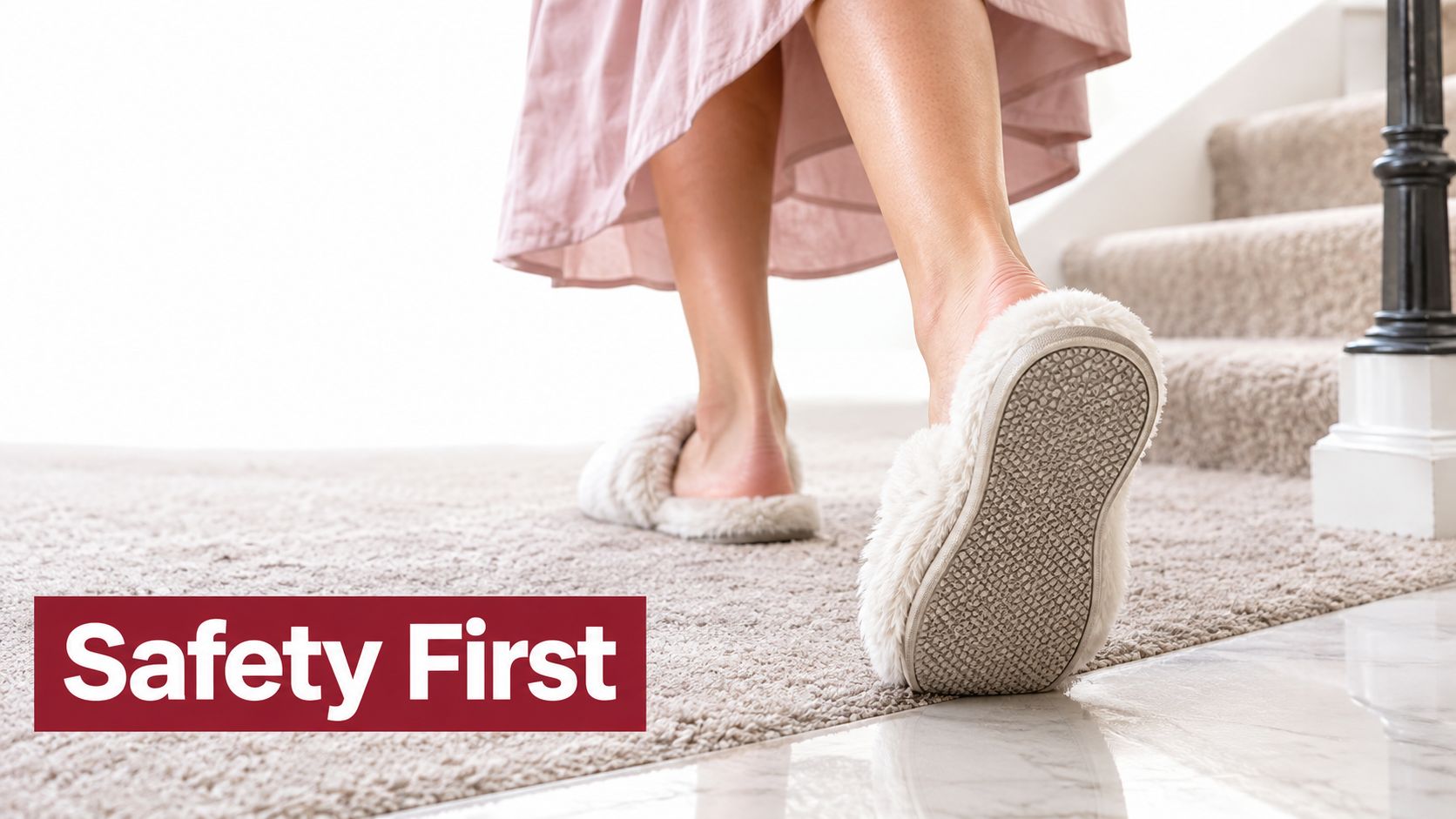
Australian falls research found slippers were the most common footwear type in 22% of fall cases, while slippery soles or slippers were identified as a factor in 9% of falls. Those findings do not make every fluffy slipper dangerous. They do make a safety check mandatory. The figures are discussed in the Australian falls research paper.
Inspect the outsole, not just the upper
Ask the supplier what the outsole is made from and request testing documentation if it is available. Queensland workplace-safety guidance explains that slip resistance depends on the conditions, because wet and dry surfaces can produce different results. Its footwear guidance for slips, trips and falls recommends matching footwear to the surface and contamination risk.
Use this checklist:
- Surface match: Assess polished tile, timber, carpet edges and bathroom floors.
- Tread continuity: Confirm that tread covers both the heel and forefoot.
- Material choice: Choose textured rubber or thermoplastic-rubber outsoles rather than smooth decorative soles.
- Marketing language: Treat “non-slip” as incomplete unless the supplier identifies the test surface, wet or dry conditions and coefficient-of-friction result.
- Use limits: Keep fashion slippers indoors, away from commercial kitchens, workplaces and contaminated floors.
Australian occupational footwear testing under AS 2210.3:2019 covers slip resistance, ergonomic, mechanical and thermal requirements. Ordinary fashion slippers are not automatically certified to that standard. Do not describe a bridal accessory as certified safety footwear without supporting documentation.
Consider who will wear them
The wearer matters as much as the product. Australian research involving inpatients from five Queensland hospitals found 55% mainly wore non-protective indoor footwear, including slippers at 21% and backless slippers at 7%. La Trobe researchers found that enclosed slippers with Velcro fasteners and firm soles supported better balance in older women than backless slippers or socks. Their work also reports that around one in three Australians over 65 falls each year, with up to 15% of falls causing serious injury. The findings appear in this study of indoor footwear and falls risk.
For a young bridal party walking carefully on dry carpet, a well-made fluffy slipper can suit a short, supervised preparation period. For stairs, wet bathrooms, outdoor paths, older relatives, reduced balance, a history of falls or foot-ulcer risk, choose an enclosed shoe with fastening and a firm, slip-resistant sole instead. Safety should decide the design before colour or personalisation.
Matching Slippers to Robes and Pyjamas
A bride's morning can look coordinated without forcing every bridesmaid into an identical outfit. Choose a clear visual system, then apply it across robes, pyjamas and slippers. The 2025 Easy Weddings survey reported that approximately 41% of Australian couples selected a fully uniform bridal-party look, while a further 35% preferred a coordinated colour scheme, according to the 2025 Easy Weddings survey.
Use identical slippers with matching satin robes for a clean photograph. For a more flexible result, keep the slipper colour consistent while allowing personalised titles, different robe cuts or varied pyjama styles. That approach works better for a diverse group, especially when fit, mobility or personal preference rules out one shared silhouette.
Build the look around the robe
Satin robes have a soft sheen. Pair them with smooth fleece or refined faux fur instead of a heavily rustic textile. Lace robes can support more texture, so a fluffy crossover style can look cohesive without making the outfit appear crowded. With floral robes, select one slipper colour from the print and avoid adding another competing pattern.
Crossover designs show more of the foot and create a neat line below the robe hem. They must still stay secure. A stable upper and firm outsole matter more than an oversized trim or a photogenic shape.
Texture also affects proportion. luxury faux fur robes carry enough visual weight to suit a substantial slipper, while a lightweight satin robe usually looks sharper with a neater, less bulky pair. Check that the slipper does not drag on the floor or make the wearer alter her stride.
The same 2025 Easy Weddings survey found that 70% of couples thanked guests with bomboniere or wedding favours, with the figure covered by the survey link above. Personalised slippers can therefore work as both morning accessories and practical keepsakes for bridesmaids, mothers or flower girls. Keep the colour plan consistent, then choose the safest, best-fitting design for each wearer. A coordinated bridal party looks better when everyone can walk comfortably.
Personalisation and Care for Lasting Memories
A name, role or short title turns a pair of slippers into a deliberate gift. Bride, Maid of Honour, Bridesmaid, Mother of the Bride and Flower Girl make the morning feel organised, while names create a keepsake people can use after the wedding. The personalisation should be legible, correctly spelt and positioned where it will remain visible in photographs.
Place the order carefully
Start with the wearer list, then confirm the design before submitting personalisation. Record:
- Role or name: Check spelling, apostrophes and capitalisation.
- Colour and finish: Match the writing with your robes and pyjamas.
- Size information: Keep the measurement record beside the personalisation list.
- Delivery timing: Allow time for checking, exchanges and any contingency pairs.
- Packaging: Group each pair by person so the morning's gift distribution takes seconds.
For a practical example of how custom bridal details can be arranged, review monogramming services. Get Spliced is one Australian option that offers fluffy fleece slippers for bridal-party roles, with silver, rose-gold or gold writing, and describes them as one-size-fits-most indoor footwear. Treat that description as a starting point, not a reason to skip the fit check. One-size-fits-most doesn't mean one-size-fits-everyone.
Protect the plush finish
Keep fluffy slippers away from makeup spills, self-tan, hair spray and drinks during preparation. Store each pair in a breathable bag rather than compressing the lining under heavy items, and let damp footwear dry naturally away from direct heat. Don't put a plush slipper into a washing machine unless the care label specifically permits it.
Before the event, inspect the upper, stitching, heel area and outsole. Compress the lining by hand, check whether the foot still sits securely, and walk across the actual indoor surfaces where the group will prepare. This small rehearsal catches loose fits and smooth soles while there's still time to change the plan.
The most thoughtful personalised gift is one that remains comfortable after the photograph. Keep the beautiful details, but insist on a fit, sole and care routine that make the slippers useful beyond the wedding morning.
Choose your bridal-party slippers by measurement, outsole construction and intended use before selecting the colour or title. Create one organised list for names, roles, foot measurements and sizes, then order early enough to test the lining, heel retention and grip on the surfaces your group will use. Your robes may create the photograph, but comfortable, secure ladies fluffy slippers will make the morning easier for everyone.