

You've found a floral lace robe that looks beautiful on screen, but the wedding morning won't happen under studio lighting. There'll be a bright window beside the makeup chair, a warm verandah for group photographs and bridesmaids who need different amounts of coverage. Before choosing the flower pattern, check how the robe behaves in that light, how it closes when you sit down and whether you'll enjoy wearing it afterwards.
The most useful choice balances fabric, opacity and individual fit. A romantic silhouette matters, but not at the expense of spending the morning adjusting a neckline or feeling too warm beneath a heavy slip.
Floral Lace Robe Styles Compared at a Glance
A floral lace robe is a robe with botanical motifs, often embroidered or appliquéd onto a sheer net base, worn over a slip or nightwear during getting-ready preparations. Some designs use lace throughout; others combine solid fabric with lace panels, cuffs or hems.
Lace has a long Australian retail history: the National Museum of Australia holds sample books from around the 1890s, containing machine-made lace apparently sold through Sydney retailer F. Lassetter & Co., which helps explain its established association with occasion dressing.
Floral lace robe styles by use, coverage and climate
In this comparison, high opacity means less see-through coverage. The lining, rather than the density of the flowers alone, determines how confidently you can wear the robe in bright light.
| Style | Best for | Opacity in bright light | Photo look | Climate note |
|---|---|---|---|---|
| Full-length floral lace robe | Bride and morning-of portraits | Moderate with a lining; sheer without one | Long, elegant line | Warm weather calls for a breathable lining |
| Knee-length floral lace robe | Bridesmaids and hen's day | Low to moderate | Relaxed, good for close detail | Suits humid days with a lightweight underlayer |
| Floral lace robe with matching slip | Brides wanting full coverage | High when the slip is opaque | Smooth, layered look | Wear the slip in bright outdoor light |
| Lace over satin robe | Mothers and formal getting-ready | High with an opaque satin base | Structured and polished | Heavier, better for cool mornings |
| Short floral lace robe with sleeves | Flower girls and hen's parties, with suitable underlayers | Low | Playful and youthful | Least coverage in direct sun |
A full-length robe photographs as a continuous line, particularly when the hem clears the floor rather than pooling around slippers. It's a strong portrait choice, but less convenient around stairs, makeup stools and crowded preparation rooms.
A knee-length robe leaves more room to move on humid days and works well for seated photographs or close details of cuffs and bouquets. A short robe can suit younger attendants when worn over proper nightwear, but gives the least coverage when bending or sitting.
Practical rule: Choose the cut for the location and light your photographer will use, not for the flower pattern alone.
If you prefer a more solid-looking base, compare floral satin robe options before committing to all-over lace. A printed floral surface and an openwork floral textile can create quite different results.
Fabrics and Construction Behind Floral Lace
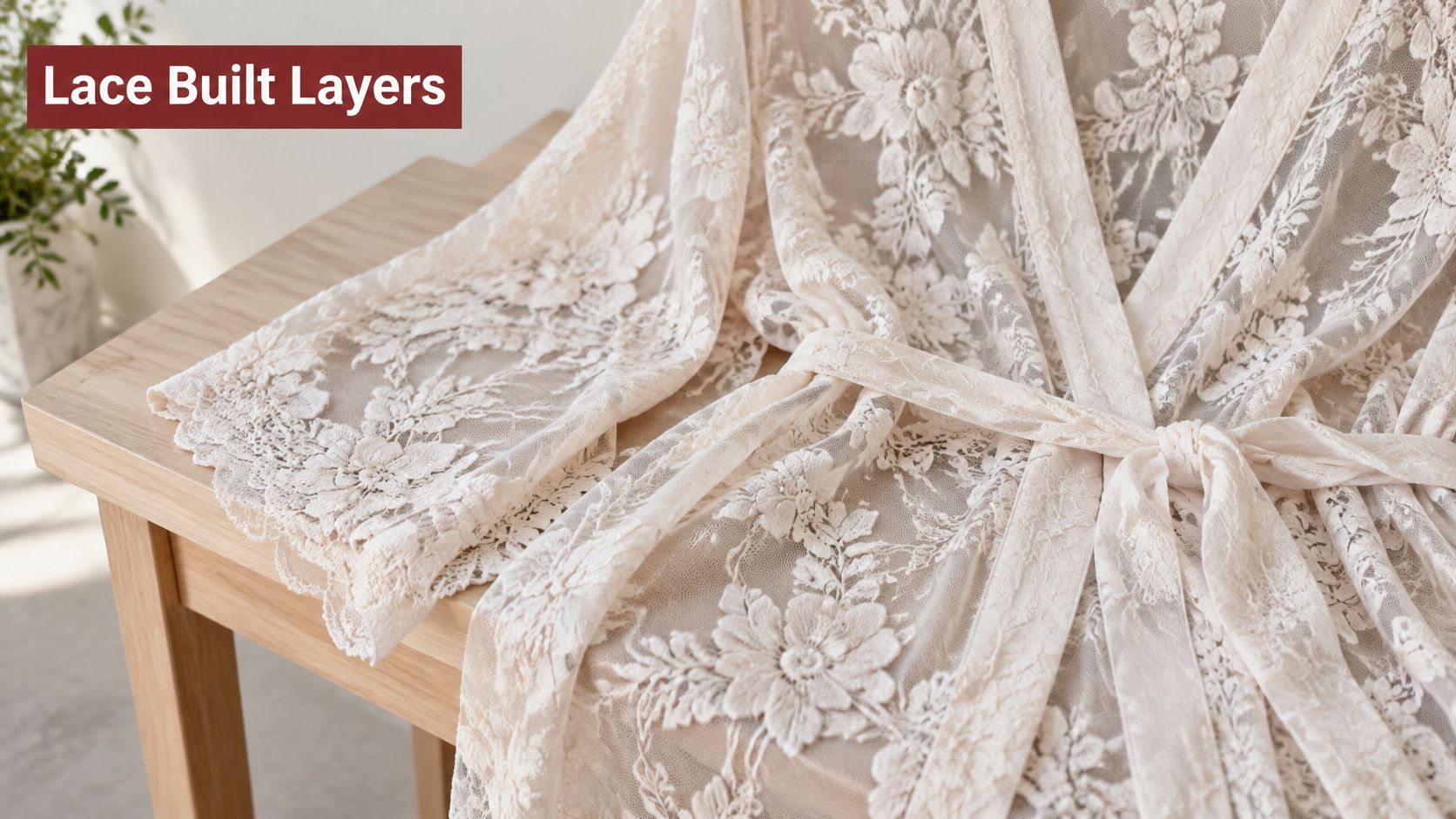
The word lace describes the textile structure, not its fibre content. A floral design might have motifs stitched onto net or tulle, or flowers formed within the lace itself. Bonded appliqués are another construction, so inspect the description rather than assuming every floral surface is embroidered.
Think of embroidery on a tablecloth: the stitched flowers feel denser than the fabric between them. On a robe, those concentrated motifs can add weight and stiffness around the bust, cuffs or hem while the open ground remains fluid.
Lace fibres and linings compared for bridal wear
These are useful starting points, not guarantees. Yarn thickness, mesh openness and the lining can change how a finished garment feels.
| Fibre or lining | Feel and drape | Breathability | Key care point |
|---|---|---|---|
| Cotton lace | Soft, with some body | Generally high in an open construction | Protect dyed cotton from fading; wash cool and separately when permitted |
| Nylon lace | Smooth, light and flowing | Moderate in an open construction | Avoid high dryer heat |
| Polyester lace | Often firmer, with good shape retention | Generally lower than comparable cotton construction | Check care instructions for the lining and trims |
| Cotton and polyester blend | Balanced drape and firmness | Moderate | Follow the sewn label; a cool gentle cycle may be suitable |
| Elastane-blended lace | Stretchy, closer-fitting | Moderate in an open construction | Heat and excessive stretching can distort motifs |
| Cotton or satin slip lining | Adds opacity and a smoother outline | Cotton usually feels airier; dense satin can feel warmer | Launder separately if detachable and permitted |
Satin is a weave, not a fibre. A satin slip could be polyester, silk or another composition, so don't judge its warmth or care requirements by the word satin alone.
Inspect the parts that carry tension
Look closely at the belt loops, underarm seams and neckline edge. A narrow seam allowance or loose attachment point is worth questioning before purchase because those areas take strain whenever you reach, sit or tie the robe.
For photographs, check whether the floral motifs sit smoothly across the front opening. Dense appliqué near the neckline can look sculptural, but it can also make the edge stand away from the body.
Australian clothing and textile care-labelling guidance explains why instructions must account for washing, bleaching, drying, ironing and dry-cleaning. A robe's outer lace, lining and embellishments need compatible treatment, so check the actual composition before deciding it'll be easy to maintain.
Choosing for Australian Heat, Sun and Photo Light
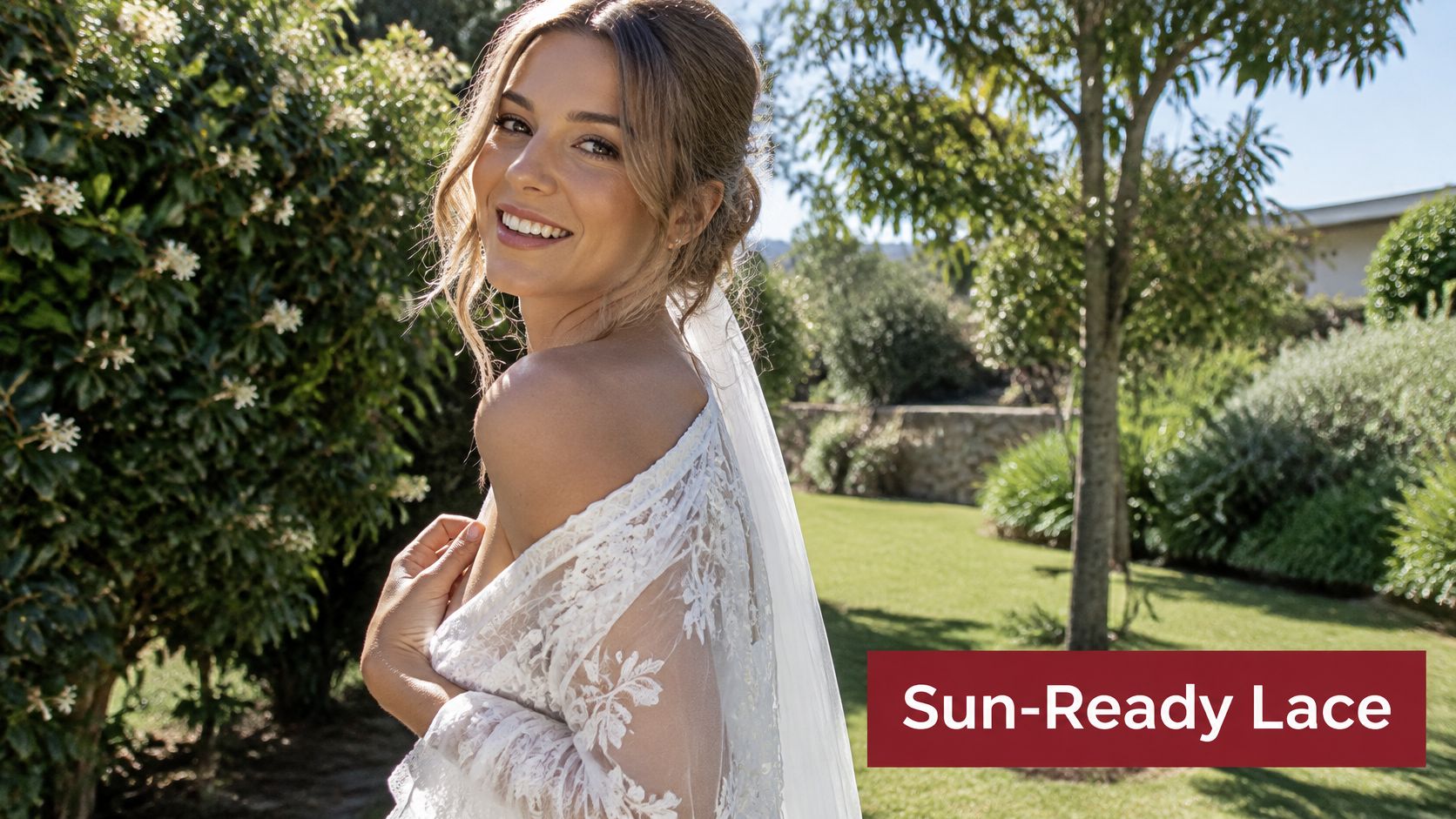
A garden or winery portrait at midday can be the moment a robe becomes uncomfortable. Indoors, the open lace felt light; outdoors, the lining feels warm, bare shoulders are exposed and the bright sky makes the fabric look more transparent.
Plan around the actual portrait time, not just whether the wedding falls in summer. A shaded preparation room and an exposed lawn need different clothing and photography decisions.
Separate decorative coverage from sun protection
At a UV Index of 3 or above, ARPANSA's sun-protection clothing guidance recommends combining sun-protective clothing, broad-spectrum water-resistant SPF50 or SPF50+ sunscreen, a broad-brimmed or legionnaire-style hat, shade and sunglasses that meet Australian Standards.
Decorative lace isn't a tested sun-protective garment unless it carries an appropriate rating. Being covered by visible flowers doesn't establish how much ultraviolet radiation the fabric blocks.
UV Index and robe choices for outdoor bridal photos
| UV Index or label | Recommended action | What it means for the robe |
|---|---|---|
| Below the sun-protection threshold | Minimal protection is generally needed | The robe can work alone for short shaded portraits, subject to individual needs |
| At or above the sun-protection threshold | Combine protective clothing, hat, sunglasses, shade and sunscreen | Don't rely on open lace to protect exposed skin |
| Garment with a tested sun-protection label | Follow the rating and coverage information | Trust documented performance, not the appearance of dense floral motifs |
| Open back or short sleeves | Protect uncovered areas with shade and appropriate sunscreen | Gaps remain exposed even if other fabric is protective |
A UPF 50 garment is intended for outdoor protection, but ARPANSA's Australian Standard guidance makes clear that protection applies only to covered skin and can decrease when material is wet, stretched or worn. An open back, therefore, remains an open back regardless of the rating elsewhere.
ARPANSA also advises that people can generally remain outdoors with minimal protection below a UV Index of 3, while its Australian ultraviolet radiation guidance explains why conditions should be checked for the location and time.
Test the complete outfit in daylight
- Face a bright window: Wear the intended slip and undergarments, then photograph the front, side and back.
- Check direct light briefly: Look for visible underwear edges, sheer side panels and gaps between motifs.
- Move rather than pose: Sit, reach for a glass and walk towards the camera to check the wrap opening.
- Assess warmth: Try the complete outfit somewhere warm, not only in an air-conditioned bedroom.
- Confirm the forecast: Give the planner and photographer the local UV forecast for the proposed portrait time.
For humid weather, I'd prioritise a removable, lightweight underlayer over a permanently heavy lining. For cooler mornings, an opaque layer can provide welcome warmth without changing the lace's decorative effect.
Sizing and Fit Across Brides and Bridal Parties
A robe chosen by dress size alone can pull across the bust while still feeling loose at the waist. Non-stretch lace won't accommodate that tension comfortably, and even stretch lace needs enough fabric for the front panels to overlap.
Start with a soft measuring tape and a helper. Keep the tape level, stand naturally and avoid pulling it tight to produce a smaller measurement.
Measurements to take before choosing a floral lace robe
| Measurement | How to take it | Why it matters for the robe |
|---|---|---|
| Bust | Measure around the fullest point, keeping the tape level and snug, not tight | Sets chest room and the front opening |
| Underbust | Measure directly beneath the bust with arms relaxed | Helps assess wrap overlap and tie placement |
| Hip | Measure the fullest point with feet together | Stops the lower panels pulling apart |
| Robe length | Measure from the seller's specified shoulder point to the intended hem | Sets the photographic line and walking clearance |
| Sleeve length | Measure from the specified shoulder point towards the wrist, arm relaxed | Helps assess sleeve coverage and cuff position |
| Height | Stand barefoot against a wall | Helps interpret model photographs and likely hem position |
The bust measurement establishes room across the chest, but check whether the size chart describes body measurements or finished garment measurements. A finished robe needs wearing room and wrap overlap, not merely enough fabric to meet edge to edge.
Underbust is particularly useful for a wrap robe. If a wearer has a fuller bust and narrower torso, tightening the belt may secure the waist without creating enough coverage above it; a better-cut front panel or separate slip solves that more effectively than a tighter knot.
Coordinate colour, not body shape
Australian couples are already making room for individual styling: Easy Weddings' industry insights report that 13% of couples chose mismatched or relaxed bridesmaid dresses in 2025. Apply the same flexibility to preparation wear by keeping a shared palette while choosing suitable lengths and sizes.
Use the hip measurement to check seated overlap, not only standing fit. Compare shoulder-to-hem length with each person's height, and check sleeve length separately because a model's elbow-length sleeve may sit much lower on another wearer.
Matching photographs don't require identical cuts. Comfortable posture and secure coverage create a more cohesive group than everyone adjusting the same robe.
For broader sizing considerations, the plus-size bridal robe guide offers another useful starting point. Measure in the undergarments planned for the morning, record measurements in centimetres and compare each person individually against the garment's size chart before ordering.
How to Wash and Dry a Floral Lace Robe Without Damage
Wringing can distort open motifs, while heat and bleach can damage a delicate robe's appearance. Dyed cotton also needs particular care: an RMIT study of reactive-dyed cotton under Australian laundering conditions found increased colour loss with detergent exposure, faster fading under wet ultraviolet exposure than dry exposure, and additional colour loss from oxidising bleach.
Those findings concern the cotton and dyes tested, not every lace fibre. They're a good reason to treat a pale cotton robe gently rather than assuming a bridal garment can tolerate an ordinary mixed wash.
A careful washing routine
- Read the sewn care label first. Follow it over any general advice, particularly for bonded motifs, embellishments or a robe marked for professional cleaning.
- Inspect embroidery and attachment points. Check monograms, belt loops and appliqués for loose threads, and arrange repairs before washing so agitation doesn't enlarge the damage.
- Pre-test an inconspicuous seam. Press a damp white cloth against the fabric and check for colour transfer; stop if dye transfers, noting that a successful spot test doesn't guarantee complete colourfastness.
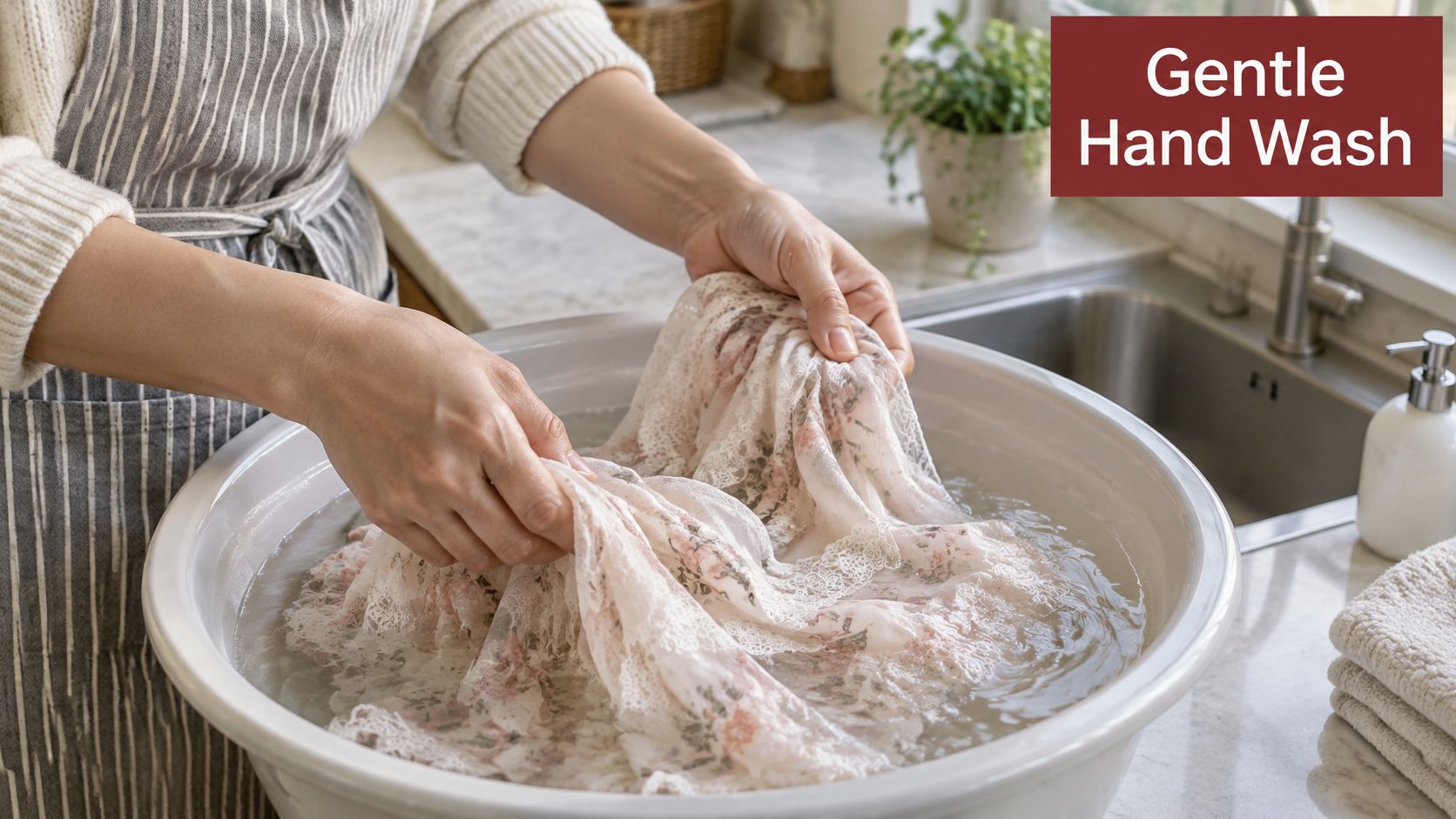
- Protect the lace during washing. If laundering is permitted, use a mesh bag on a cool delicate cycle or hand wash gently in lukewarm water; fasten any zips or hooks and keep rough garments out of the load.
- Choose a gentle detergent. Avoid bleach and optical brighteners, measure detergent carefully and wash separately or with similar colours.
- Press out water without wringing. Support the wet robe, lay it on a clean towel and press gently rather than twisting the sleeves or pulling the hem.
- Dry with the garment supported. Lay it flat, or use a padded hanger only if the label and garment weight allow, keeping it out of direct sunlight and away from heaters.
- Store only when completely dry. Fold with acid-free tissue or hang a lightweight robe in a breathable garment bag, ensuring heavy embroidery isn't dragging on the shoulders.
Avoid the quick fixes that create more work
A rinse-only treatment isn't automatically harmless for reactive-dyed cotton, because water exposure can also contribute to fading. That matters when you're trying to preserve the subtle colour of a blush or ivory robe, so avoid repeated unnecessary wetting.
Don't rub makeup or tanning marks aggressively through the lace. Blot carefully, check the permitted stain treatment and seek professional advice if the mark remains.
Keep the garment care instructions accessible after the wedding rather than relying on memory. Before packing the robe away, make sure detachable slips, belts and any care information stay together.
Styling Floral Lace Robes for Getting-Ready Photos
The strongest styling choice is often to remove something. Lace already provides pattern, texture and an interesting edge, so it rarely needs statement jewellery, a busy background and several props competing for attention.
A quiet window portrait
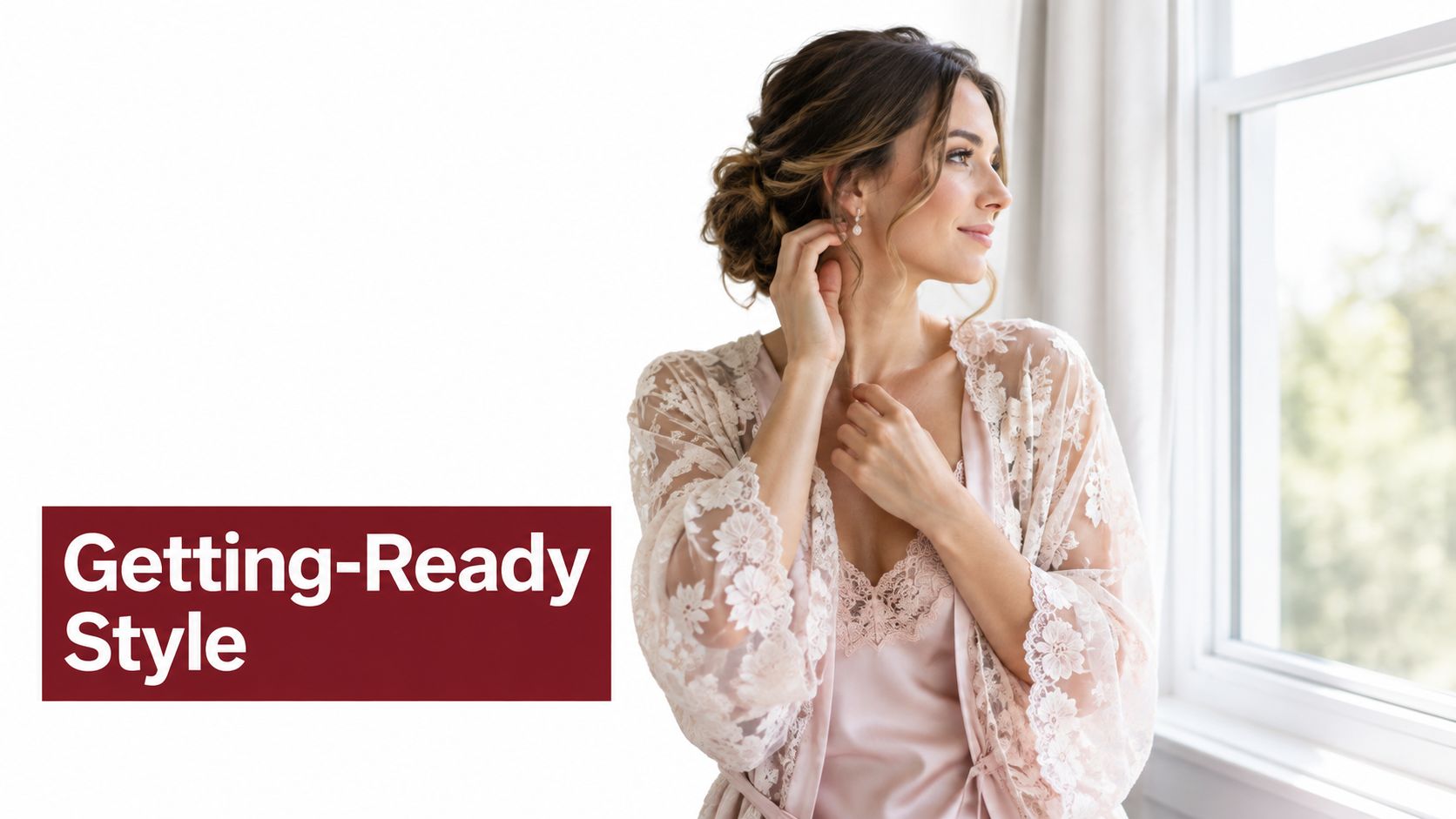
Say the bride wears a pale blush robe with a matching slip beside a south-facing window. In Australia, that orientation can offer soft, indirect light rather than the stronger direct sun entering from the north, although nearby buildings and reflected light still affect the result.
Place her slightly back from the glass and turn her gently towards it. Small earrings and a simple hairpiece let the floral motifs remain visible, while a clear background prevents the lace edge disappearing into clutter.
A coordinated bridal-party photograph
For a champagne palette, the bride might wear a fuller robe while bridesmaids choose knee-length versions in related tones. Gather the group beside an uncluttered bed or along a shaded verandah, leaving enough room for each robe's outline to remain visible.
Keep slippers within the bottom edge of the frame if they're part of the outfit. A champagne flute or bridal box can give someone's hands a natural position, but don't ask every person to hold a different object.
A garden portrait at midday
For an outdoor portrait, choose even verandah or tree shade before choosing the pose. Avoid patchy sunlight across faces and position the group away from a bright sky background, which can make delicate white lace harder to expose clearly.
A botanical hairpiece can echo the robe without matching every flower. Ask the photographer for a small range of purposeful images:
- Lace detail: A cuff, shoulder or embroidered hem against a simple background.
- Full-length back view: Enough space to show the neckline, belt and entire hem.
- Relaxed movement: A gentle turn or candid conversation rather than a stiff line-up.
Choose the Right Robe for Your Bridal Party
A robe needs a purpose beyond a photograph. Australian clothing figures reproduced in the Easy Weddings survey document cite average annual purchases of 27 kg of clothing per shopper and disposal of 23 kg, making repeat wear a worthwhile purchasing test.
Ask each recipient whether they'd use the robe on a honeymoon, as a maternity or special-occasion layer, or for a hen's celebration. Don't assume everyone wants another garment just because the group photograph would look coordinated.
Buy for the wearer's actual needs
- For the bride: Prioritise a robe that suits the planned photographs and feels comfortable through hair and makeup.
- For bridesmaids: Agree on a palette, then allow individual fit and coverage preferences.
- For mothers and flower girls: Choose appropriate underlayers, manageable hems and sleeves that won't interfere with preparations.
- For everyone: Check that the care requirements suit how they realistically wash clothing.
Individual robes allow more personal choice, but require closer checking of colours and finishes. A coordinated set simplifies selection, although it's poor value if someone receives a size or cut they won't wear.
A design suitable for ordinary home use may offer better cost per wear than a heavily themed garment. Calculate that by dividing the total purchase cost by realistic future wears, not by an optimistic plan to use it regularly.
Make personalisation earn its place
The Get Spliced Iris Floral Lace Robe is one personalised option to assess alongside an unpersonalised lace robe or a simpler nightwear set. If considering monogramming and crossover slippers, confirm the current product details directly and check the robe against your measurements before ordering.
Personalisation doesn't automatically improve value. Initials may suit future wear better than a wedding-role title, while an unpersonalised robe may be easier to pass on; before resale or donation, repair loose seams, clean it appropriately and disclose any damage.
A useful keepsake is something the recipient wants to keep, not something they feel obliged to store.
For a palette that connects preparation wear with the ceremony, browse bridesmaid bouquets from Fiore and compare the flower tones with fabric samples in daylight. Aim for complementary colours rather than an exact match between every petal and garment.
This week, measure each wearer, confirm the care label and outdoor UV plan, then choose the cut. Request any missing information about lining, wrap overlap and personalisation before ordering, so the robe arrives ready for the morning you've planned.